Saturday, June 25, 2011

"On an island in the sun..." or "Please please please, Sister Socrates..." or "When I think back on all the crap I learned in high school, it's a wonder I can think at all..."

After a long bus ride from Sofia, Bulgaria, I finally arrived in Athens, the historic capital of Greece. I was expecting to meet some family there in a few days (Maggie and Bob). However, in an amazing display of generosity, Bob offered (and insisted) on getting me out to Santorini to meet them immediately. That’s how, after only one afternoon in Athens, I found myself on a puddle-jumper plane towards the Greek Isles. I arrived in Santorini late at night and promptly met Maggie and Bob at their hotel, a beautiful resort of white clay buildings overlooking the pristine coast of the island. The view from our room was beyond postcard material, and it was exactly how I'd always imagined the picturesque beaches of Greece. The hotel itself was luxurious and something to see. After months in dingy hostels, the Perivolas resort felt beyond delux to me. It was wonderful to rest and soak in the views. We drove all over the small island, went snorkeling, lounged on the black sand and stone beaches, and browsed the upscale tourist shops. Of all the places I've been, Santorini is a serious contender for the most beautiful. Here are some photos:
View from our hotel in Santorini.
Again.
Church in Santorini.
View around sunset.
Sunset in Santorini.
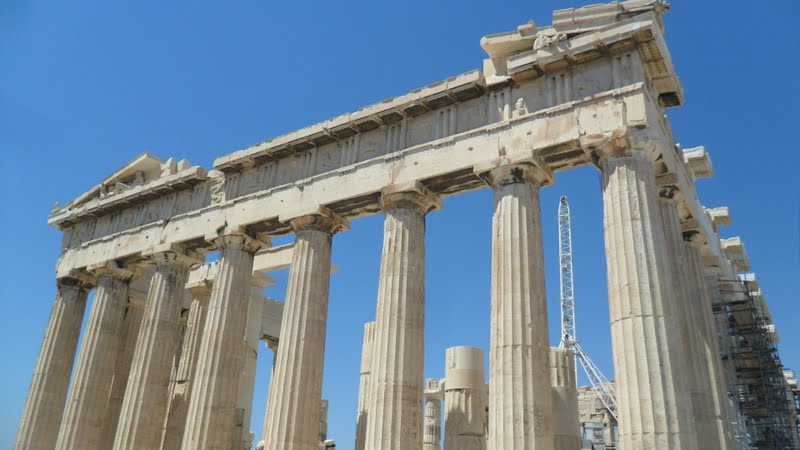
We left Santorini for Athens after a few days. I really enjoyed the city during the afternoon I was there, so I was glad to get back and see it more deeply. Athens radiates with a sense of history. It’s extremely cool to just walk around. It’s a fully functioning city, but it all exists in the shadow of breathtaking ruins like the Acropolis and such. There are millennia-old ruins everywhere. It really puts human history in perspective to hear someone say, “Yeah, those Ionic columns were built around the 4th century B.C.” We toured the Acropolis. I saw the Temple of Olympian Zeus. I also visited the Ancient Agora, which is where Socrates used to hang out in his philosophical heyday. I’ve always been a big fan of Socrates, so I was really stunned to be able to check that out. Again, all of those sights are especially amazing because they are right in the heart of a bustling modern city. Here are some photos of Athens:
Temple of Olympian Zeus, Athens.
The Ancient Agora, where Socrates used to hang out.
The Parthenon.
Another view of the Parthenon.
Statues outside a temple on the Acropolis.
Maggie and I in Athens, with the Acropolis in the background.
If you’ve been paying any attention to the news these past few weeks, you’re probably under the impression that Greece’s economy and stability have gone to Hell in a hand basket, as they say. Indeed, when I decided to visit Greece, I received several emails warning me of riots in Athens over the crumbling economy and the incompetency of the government. I had not been paying attention to the news, so I was unaware of just how bad the economy in Greece had gotten. Bob’s travel agent even recommended that he switch hotels in Athens (which we did) due to security concerns near the city center. In other words: if there’s a rebellion, you don’t want to be there.

My first day in Athens (the single afternoon by myself before I flew to Santorini to meet them), I accidentally wandered into Constitution Square, an open area downtown that houses the Parliament Building. If you’ve seen newscasters reporting on the riots and mass demonstrations in front of hoards of protestors, they are probably broadcasting from Constitution Square. Anyway, I accidentally wandered over there and found tons of people camped out in front of Parliament. There were political booths, rally signs, and literature all over the place. I strolled around, and everything was fine.

Word.

Protest sign in Constitution Square, Athens.
When I arrived back in Athens with Bob and Maggie a few days later, the hotel’s concierge told us that the demonstrations would start around 7, so we might want to “avoid” the Parliament Building after that. Instead, we ended up right in the middle of the crowd. The scene was pretty amazing: young protestors with megaphones, crowds shouting slogans, people booing members of Parliament as they walked into the building, et cetera. Demonstrators, and later police, blocked off the road to cars. We hung around for a bit and soaked it all in. If I could understand Greek, I probably would have appreciated it more. Here’s what it looked like:
Flag waving.

Demonstrators.
Chanting slogans.
 
Barricades: demostrators vs. police.
Mass demonstrations (not riots) outside the Parliament Building.

In spite of all of the demonstrations, all of the protestors, all of the discontent, and all of the reports of riots, there was never a moment of actual danger throughout my time in Athens. One night, we came back to our hotel immediately after leaving the night-time demonstrations at Constitution Square. I turned on CNN and BBC, only to see their reporters sensationalizing the reality on the ground. Later, in a lead-in to a story about the Greek economy, CNN ran a photo of a group of rioters being dispersed in a cloud of smoke. The implication: Athens is crumbling! Save yourselves!

Keep in mind: I had just left the area of town they were discussing. However, there were no riots there. There wasn’t even any threatening language. Actually, the whole thing seemed frustratingly benign. These were not anarchists tossing Molotovs into corporate windows. They weren’t setting fire to overturned police cars. It bared more resemblance to Bonnaroo than a revolution. There were food vendors and street performers, for God’s sake.
Which leads me to another thing I’ve learned while traveling (on this trip and others): things are hardly ever as bad as the media and fear-mongers in the United States present them to be. On this trip, I have been in several supposedly “compromising” or “unsafe” situations. I was in Thailand when the border war with Cambodia flared up early this year. I visited Burma, a military state that even I was shocked I could enter. I was in India (Pakistan’s unwelcome neighbor) riding public transportation as the U.S. embassies all over the world issued warnings not to do that in the wake of Osama bin Laden’s death. Jobi and I were planning a trip to Morocco until a terrorist bombing in Marrakech forced us to reconsider. This week, I was in downtown Athens amid the “riots.”
And what’s amazing is that I never—not once—felt the least bit concerned about my safety. There was almost no actual danger in these places for a traveler like me.
The media deserves some of the blame. After all, any for-profit newspaper would much rather print a photo of the one guy tossing a brick through a window rather than the thousands of others who are peacefully demonstrating in front of the Parliament Building. That’s understandable, I suppose.
Another part of the blame belongs to something even more nebulous than the media, though. A lot of it is the culture of fear that pervades America. While on a bus in Bulgaria, I met an American girl who had traveled by herself to Kabul—yes, the capital of Afghanistan—in 2008. In Belgium, I met an Argentinian guy who was encouraging me to go to Cairo because of the cheap deals and great times he’d found there in the wake of the recent rebellion. Last week, I met a couple of French guys who were on their way to Iran on a tourist visa. These people did not seem obsessed with security concerns, and their travels were all the more enriching for it. Indeed, they, too, found that “unfriendly” countries are a lot more accommodating than we might imagine.
We are constantly indoctrinated with a certain fear of “the other.” It’s not conspiratorial or calculated, but it exists. We can see it in school textbooks (e.g., terms like “Third World”), in the “us against them” language of politicians, in the excessively cautious advisories issued by the State Department, in the sensationalist media outlets, and in the well intentioned fears of family and friends.
The sad truth is that bad things happen everywhere in the world all the time, yet I have felt safer throughout my travels than I feel in many cities in the United States. I understand the security concerns of America. I understand that I can’t waltz around the streets of Baghdad without accepting a certain level of risk. However, it’s important to keep these fears in perspective. If a single American female traveler can navigate the streets of Kabul, then I think that’s proof enough that we should pump the breaks when it comes to the fear rhetoric. These places are accommodating, and often the xenophobia subtly cultivated by our society is completely unfounded. I didn’t get arrested by the government of Burma; I wasn’t swept up in the so-called “riots” of Athens; the military skirmish in Thailand wasn’t anywhere near affecting me; and India was business-as-usual in the wake of Osama’s killing. Was I tempting fate in all of these cases? No. I wasn’t “lucky.” If it seems that way, it's only because we have such fearful and negative expectations when it comes to Americans traveling abroad.
I often say that traveling is good for people because it forces them out of their comfort zones. However, the implication is a bit misleading. By escaping my comfort zone, I don’t become uncomfortable (or unsafe). Rather, I simply realize that I have restricted my comfort zone too conservatively, that most people in the world mean me no harm at all, and that the world can be a pretty welcoming place if you return the sentiment. I haven’t been proven wrong yet, and I don’t think it’s because I’m lucky.
“Be well, do good work, and keep in touch.”


.

Thursday, June 16, 2011

"Let me hear your balalaikas ringing out, come and keep your Comrade warm..." or "If I could find a souvenir just to prove the world was here..."

My plans have changed a whole lot throughout the course of this trip. I have had to miss cities that I really wanted to visit, and I have randomly found myself in others that I never could have foreseen. If there's one thing I have learned about traveling during this trip, it's that it's difficult to stick to a plan--and that's usually for the best.

I never intended to visit Bulgaria in my lifetime. Up until around 3 days before I left, I still thought I would bypass the country. However, I left Istanbul about 6 days ago on an overnight bus bound for Sofia, Bulgaria's capital city, and I could not be happier that I did.
At first glance, Sofia is not a particularly remarkable city, and I felt pretty underwhelmed on my first day there. However, the city does have loads of interesting sights and history. Often, though, it's easy to miss these sights until you're literally right upon them. The churches and statues and such are all hidden in the folds of urban landscaping and tall buildings. When I was walking around Sofia looking for a particular place, I would often be ready to give up, convinced that I should have spotted it already, and then I would look down a random alley or something and see a towering church. It's really strange, but also pretty cool. The churches in Bulgaria are mostly from sects of Eastern Orthodox Christianity, which look quite different from the Catholic cathedrals of Western Europe. I haven't visited many Eastern Orthodox churches, and they were quite beautiful. Here are some photos of the sights around Sofia:
A random old church right the urban center of the city.

Statue of St. Sofia, for whom the city is named.

St. Nedelia Church.

Painting in St. Nedelia Church.

Devotional candles in St. Nedelia Church.

Again, inside St. Nedelia Church.

Russian Orthodox Church.
The awesome Alexander Nevski Cathedral.

Inside the Alexander Nevski Cathedral.
On my last day in Bulgaria, I also visited Rila, a small mountain town that is renowned for its beautiful old monastery. A couple of guys from my hostel basically invited me to go minutes after I woke up, so it was a bit random. When we got there after a 3 hour bus ride, though, I was glad that I had accepted their invitation. It's a very quiet, peaceful place, and it has a wonderful church with colorful religious murals painted all over the walls. They accept foreign visitors for a low price. If I had known that, I might have rearranged my itinerary in order to stay there. Oh well. It was a wonderful day trip. Here are some photos:
The Nativity Church at the monastery.

Murals.

The grounds of the monastery.

The Rila Monastery.
I am not usually big on buying souvenirs. In fact, I had not yet purchased any souvenirs before Sofia. However, there is one type of souvenir for which I am a total sucker: communist kitsch. This is the reason that I have a big knock-off of an Andy Warhol lithograph of Mao Tse-tung hanging on my wall. I love that kind of stuff--can't get enough of it. Bulgaria, after World War II, embraced a communist government whole-heartedly, and it ran the country until the collapse of the Soviet sphere of influence in the late 80s. They never technically joined the Soviet Union (I don't think), but they supported it and wanted to join it for a short time. When I arrived in Bulgaria, I went souvenir hunting for any ridiculous remnants of Soviet souvenirs. After a few days of searching, I came upon a flea market around the Alexander Nevski Cathedral , and I felt as though I had hit the jackpot. Typically, I don't like shopping, but browsing through the Communist trinkets and such made me feel like an elderly woman browsing through Tuesday Morning. In other words, I enjoyed myself. They had Soviet propaganda pins, statuettes, flasks, shirts, nesting dolls, watches, weaponry, cigarette holders, etc. etc. I felt like I was in a wonderland of communist goodies. Here are some photos:
Aluminum statues of Lenin!

USSR (CCCP) drinking sets!

Russian nesting dolls: Stalin, Lenin, and... Elvis? I am now the proud owner of the Stalin dolls.

Soviet Zippos!

Communist compasses.

Soviet propaganda pins.

Soviet T-shirts.
I want to be clear, though: it's not a genuine historical interest that drives me to buy this kind of stuff. In spite of my more conservative friends who probably label me as a Pinko Bleeding-Heart Commie, it's also not in retrospective support of the USSR (obviously). Honestly, it's much less intellectual than all of that. In truth, I just find this stuff hilarious. To my sense of humor, there is something hysterically funny about Josef Stalin nesting dolls, Vladimir Lenin compasses, and Mao Tse-tung pocket watches. I can't say exactly why, but I think it has something to do with the seriousness and callousness of these figures projected onto such ridiculous and harmless objects. Again, this is why I have that brightly colored lithograph painting of Mao on my wall at home. It's certainly not because I agree with the Cultural Revolution or the Great Leap Forward. There's just something funny about seeing a man like Josef Stalin reduced to a nesting doll.

That doesn't explain it totally, though. I've never seen such kitsch trinkets for Fascists like Mussolini, Hitler, and Franco, but I doubt that I would find them quite so funny. I can't really say why. After all both groups (Fascists and Communists) killed millions and millions of people in the 20th century, so there's no argument to be made that Franco wasn't "quite as sinister" as Stalin. Nevertheless, I only find communist kitsch funny. I don't want a compass with a swastika on it--but if you show me one with a hammer and sickle on it, my eyes will light up. I can't say why for sure. Maybe part of it is a matter of political ideology. I lean to the Left (as my friends know), which probably makes me sympathetic to socialistic ideals. Meanwhile, I deplore fascism even in its most genuine and idealistic practice. Therefore, it would make sense that I find one funny and the other not. Stalin and Mao are equally as evil as Hitler and Franco, but there is one fundamental difference. In the cases of the formers, they represent a total corruption of and departure from the ideals of Marxism (whatever one might say of Marxism). Meanwhile, the actions of notorious fascists in history appear to me to be natural outgrowths of fascism as an ideology (militarism, nationalism, hyper-patriotism, etc etc). Put another way: no matter how strictly you adhere to fascist ideals, the worse off the people will be. That is not necessarily the case when it comes to Marxism, which in a strange way disarms tyrants like Stalin by presenting them as historical anomalies.
OK, I feel like I'm rambling now, and I'm getting close to defending Marxism. I don't want to do that. For all of you neo-McCarthyites: "I am not now, nor have I ever been, a member of the Communist Party." And that's true. My only point is that I am sympathetic to the ideals (not the ideas) of communism, and I cannot say the same for fascism. This probably accounts for my apparently arbitrary sense of humor when it comes to kitsch souvenirs of 20th century tyrannical dictators.
On the other hand, maybe there's just something inherently funnier about a Vladimir Lenin change purse.
"Be well, do good work, and keep in touch."

.

Saturday, June 11, 2011

"Now it's Istanbul, not Constantinople..." or "...by the banks of the mighty Bosphorus is a Japanese man in a business suit singing 'Smoke Gets in Your Eyes'..."

When I was in Paris, I met a couple of Australian honeymooners who had spent the first few days of their trip in Istanbul, Turkey. Istanbul has been on my “to visit” list for quite some time now, so I naturally asked them how they felt about it. The conversation went something like this:

“I’ll be spending about a week there pretty soon,” I said.
“A week?” the newlywed wife asked.
“Yeah, is that not enough?”
“I think it’s too much. You can do all of the main sights in Istanbul in a day or two.”
“Really? I feel like I’ll be able to spend a lot of time there.”
To this, she said: “Well, I guess it depends on your personality. If you’re the type of person who could spend all day in a café reading, smoking hookah, drinking apple tea, and playing backgammon, then you could probably never get bored.”
Little did she know: I am exactly the type of person who could spend a whole day in cafes reading, drinking tea, smoking hookah, and playing backgammon. After this conversation, I knew that Istanbul was going to be my kind of city.
Yes, from the old Looney Tunes music video.
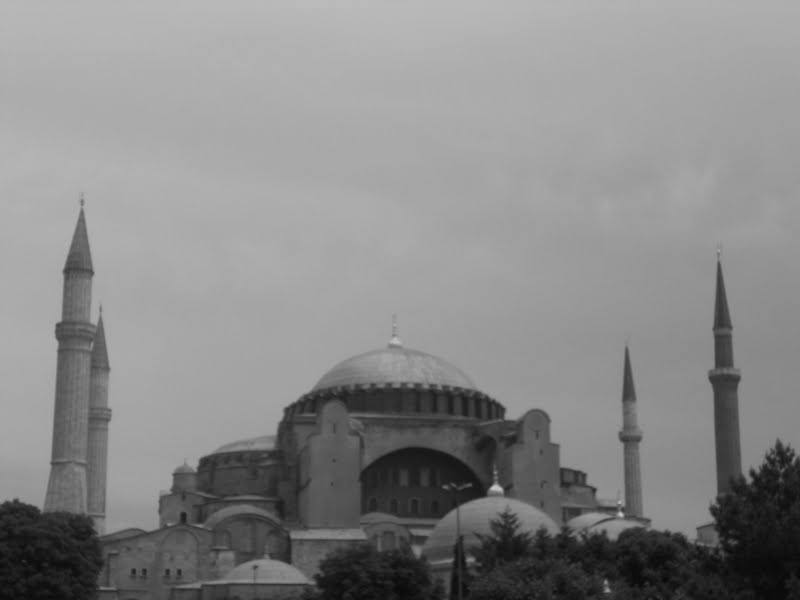
I stayed in Sultanahmet, the old district of the city that houses all of Istanbul’s main sights. After a three minute walk, I could be in the heart of the historic buildings. I visited the Blue Mosque, which is one of the more beautiful mosques I’ve ever seen. Unlike most other mosques, which (for religious reasons) tend to have a simple aesthetic and not a lot of artwork, the Blue Mosque was as artistically impressive as any European cathedral. With its vaulted domes for ceilings and chandeliers everywhere, this sight was one of the best I have yet come across in my travels. I also walked around the outside of Aya Sofya, a huge Byzantine church turned mosque turned museum, which was equally as impressive. However, I did not actually enter Aya Sofya in silent protest of the 20 lira entrance fee. At night, the whole historic area of Sultanahmet comes alive with colored lights and street vendors. It’s really beautiful, and I enjoyed just walking around the area. Here are some photos:
The amazing Blue Mosque, as seen from the courtyard.

The domes of the Blue Mosque.

From inside, the domed ceiling of the Blue Mosque.

Awesome lighting inside the Blue Mosque.

My street in Sultanahmet at night.

Fountain in the park between Aya Sofya and Blue Mosque.

I still need to figure out my camera's shutter speed, but this is Aya Sofia at night.

Aya Sofya.
All of the East-meets-West clichés about Istanbul are accurate. The city boasts all of the luxury and style of Western Europe, all of the “exotic” allure of the Middle East, and all of the rugged charm of Asia. At different times in history, it has been part of the Roman Empire, the Byzantine (the later, Eastern Roman) Empire, and the Ottoman Empire. In its modern history, Mustafa Kamel “Ataturk” (which means “father of the Turks”) unified the nation into its modern state. There are international tourists and business travelers from all around the globe. A few times, I ventured into the more modernized, less touristy areas of the city, and it only testified to the rich history: there were old Ottoman and Byzantine buildings sandwiched between modern apartment complexes. All over, I saw old Turkish men smoking hookah and playing backgammon over afternoon tea. From the roof of my hostel, I had incredible views of the city. I could see across the famous Bosphorus River into the other side of Istanbul, which is technically Asia. The city literally straddles two continents, and this unique geography has helped make it one of the world’s truly global and great cities. Even the Grand Bazaar in Istanbul is like an old Middle Eastern souq that has been upgraded to a 21st century shopping mall. More photos:
Istanbul skyline.

Rug sellers at the Grand Bazaar.

The Bosphorus. Across is Asia.
After visiting all of the sights that I wanted to check out, I basically spent the rest of my time in Turkey hanging around the various cafes and restaurants in Sultanahmet, and it never got boring. In order to become the epitome of the tourist stereotype in Turkey, I could not help but keep listening to They Might Be Giants’ cover of “Istanbul, Not Constantinople,” which I love.
Cafe/Hookah bar... or, "How I Spent My Time in Turkey"
I really enjoyed Istanbul, and it’s definitely a place to which I would gladly return. It has a great number of tourists, and it is an extremely cosmopolitan city. There are karaoke bars, nightclubs, and fine restaurants. All of these things are enjoyable, especially because, in spite of them, the city still retains the mystique and adventure assigned it by centuries of Western travelers.
There really isn’t much to add, so I guess that’s all I have to say about Istanbul. I hope all is going well back in the States.
“Be well, do good work, and keep in touch.”


.