Tuesday, May 10, 2011

"He hears the sounds, the sounds of cattle in the marketplace, scatterlings and orphanages..." or "Oh, they build buildings, oh, they build buildings so tall these days..." or "Man, I was mean, but I'm changing my scene, and I'm doing the best that I can."

It’s amazing how relevant the lyrics of Paul Simon’s “You Can Call Me Al” have become to my experiences throughout the course of this journey. This marks the third blog whose title was pulled from that song, and I have a feeling that there will be at least one more. I think it’s safe to say that “You Can Call Me Al” is my official traveling song, perhaps only rivaled by Men At Work’s classic “Down Under.”

Anyway, India often gets cited as one of the more hectic places to visit. It has the stereotypical mega-cities like Mumbai (Bombay), Kolkata (Calcutta), and Delhi. Under any other circumstances, I probably would have had to do a lot of mental preparations for the craziness of India. However, after spending the last 2 1/2 weeks in Bangladesh, I welcomed Delhi like it was Martha's Vineyard. Indeed, I must be one of the few people in the history of the world to travel to Delhi in search of a little peace and quiet. I had to fly through Delhi anyway en route to Europe, so I decided to break up the journey with a week in India. I landed in Delhi not knowing much about what I wanted to do. I visited the city very briefly during Semester At Sea, and I was eager to get a fuller taste of it. My friend Katie had been studying in Southern India all semester, so we had made plans to meet up.

Before Katie arrived, I had a few days to myself in Paharganj, the backpacker district right near Old Delhi. Much like Khao San in Bangkok or Thamel in Kathmandu, Paharganj offered the trypical comforts of a traveler's neighborhood: cheap guesthouses, restaurants, trinket shops, travel agencies, etc. The spice, vegetable, fruit, and souvenir markets around Paharganj were a sight to behold. Stumbling upon random markets is one of my favorite things about traveling. There's something that I find so exciting about the chaos of vendors hawking everything from religious art to baby clothes to mangos. In India, a Hindu nation in which cows still recieve special treatment, it adds a wonderful other dimension when there are huge cows wandering down the middle of the street, halting traffic and generally causing a commotion.

Cattle in the marketplace.
Hindu devotional art.
Fruit stand. 
Rickshaw.
Spice Market. 
Cattle. 
Goat.
View from the rooftop of our guesthouse.
On my third day in Delhi, Katie arrived. A few of her friends from the program she just completed were also in Delhi for one of the days. We basically spent our time in Delhi visiting an array of museums, archaeological wonders, religious temples, and cheap restaurants around the city. There is no shortage of history in Delhi, and the amount of tourist attractions attests to this.

First, we hit Ghandi Smitri, a museum dedicated to the life of the infamous Mahatma Ghandi. The museum, stationed in New Delhi, was one of the most interesting, interactive, and technological museums I've ever seen. The whole thing stands on the grounds where Ghandi's assassination took place, so there is a lovely memorial there, too. When I visited Delhi on Semester At Sea, we visited the spot upon which Ghandi's cremation took place, so our visit to this museum really rounded out the picture of his life in my mind. It would be contrived and cliche to muse about how wonderful Ghandi was. Obviously, everyone loves Ghandi because he's one of the most inspiring figures in history, so that's all there is to say about that.

Mural at the prayer area of Ghandi Smitri. 
The site of Ghandi's assassination.
The next day, we visited an amazing Jain Temple. Jainism, for those of you who don't know, is a religion whose core principles include a total aversion to violence of any kind. They believe in the sanctity of all living creatures, so they refuse to kill animals or to harm the environment. I had never seen a Jain Temple before, so I was excited to check it out. In truth, it did not look terribly different from a Hindu temple. However, I was totally enchanted when I learned that the Jains in Delhi had set up a Bird Hospital at the temple grounds. We were able to walk around it, and it's exactly what you are imagining: a bird sanctuary where the Jains care for and revive the pigeons and peacocks and other birds that they find with broken wings, infections, or other ailments from the struggles of being a bird in a city like Delhi. I don't know how many birds the hospital actually manages to save. If I'm being honest, I suspect it's not very many. Nevertheless, I love the idea. Throughout the temple and adjoining Bird Hospital, signs preach about the importance of caring for all animals. Meanwhile, devotees were all around the shrines of the temple praying and lighting candles and reading. It was a really beautiful sight.

I love Jains. 

Inside the bird hospital.
We also visited the Red Fort, probably Delhi's most well-known archaeological attraction. It is right in the heart of Old Delhi, and it's basically just a big wall of red brick (hence the name) that surrounds a complex of buildings from a long-since-passed Mughal rulership. The Red Fort is one of many World Heritage Sites in Delhi, so the grounds are kept in wonderful condition. Walking around the area within the fort's walls actually felt a lot like strolling through a public park.

Red Fort. 
Lahore Gate, the entrance to the Red Fort.
Market upon entering the Red Fort. 


The big mosque in Delhi is Jama Masjid, hailed by Lonely Planet as the "final architectural opus" of Shah Jahan, the Mughal ruler who built the Taj Mahal. It was definitely noteworthy.

Jama Masjid. 


By far the most amazing thing I saw in Delhi was Humayun's Tomb, a mosoleum built for a Mughal emporer by his son. I had never even heard of this World Heritage Site before, and I did not visit it during my flash-tour with Semester At Sea. Lonely Planet said not to miss it, so we decided to check it out. Lo and behold, Humayun's Tomb wa a real architectural masterpiece. I do not want to compare it to the Taj Mahal (perhaps THE great architectural achievement in the world), but it is tempting to at least put it in a slightly lower category. The tomb, like the Taj Mahal, is perfectly symmetrical on all sides, with a big white dome over the center. Maybe it was because I did not know what to expect from the site, but the tomb absolutely blew me away. I know next to nothing about the Mughal Empire, but their rulers certainly knew how to build amazing buildings.

Humayun's Tomb.
Again. 
Again. With fountain.
Again. With me.
At all of these attractions, hoards of Indian people constantly came up to us asking for their photos taken with us. Of course, we obliged them, but it got awfully tiresome after a while.

Right back 'atcha, Paparazzi.
The last site we visited in Delhi was the Baha'i Lotus Temple. Baha'i is a relatively recent religion (less than 200 years old) that preaches the underlying unity of all of the world's religions. It claims that all of the prophets throughout history (Abraham, Krishna, Moses, Buddha, Jesus, Muhammad) have all been sent by God to offer another revelation in an ongoing process. In other words, all of the famous prophets have introduced a new peice to the puzzle because humanity is not capable of understanding the Truth all at once. It's a pretty interesting take on religion. The building itself is shaped like a giant white lotus flower. Inside, people from all faiths are welcome to sit in silence to pray, think, or meditate. Meanwhile, the Baha'i volunteers who work at the temple are extremely friendly and inviting and warm, regardless of whether or not you have any interest in conversion. It was like talking to a Mormon without being creeped out. The grounds also have an information center that strives for peace among the world's religions--obviously, an ambitious and worthy goal.

Lotus Temple.
In India, there seems to be a scam or con around every corner. On the streets of Paharganj, there is always someone "wanting to practice their English" or "offering free information at their travel agency" or "showing tourists around their shops for free." It gets extremely frustrating having to constantly fend them off. I have dealt with them all over throughout the course of this trip and others, but India takes it to a whole new level. Meanwhile, there are genuinely desperate people on the street begging for money. Most sources say not to support begging by giving money, as that will only perpetuate the problem. I have generally heeded this advice, ignoring the homeless and poor who approach tourists. On our last night in Delhi, we happened to meet a kind man from Bhutan, the Buddhist kingdom in the Himalayas. Bhutan is a majestic place, from I have heard and read. I wanted to travel there on this trip, but it costs nearly $200 per day to be there as tourist. It is all part of the governments plan to preserve Bhutan's cultural heritage and sheild it from the damage done by over-tourism. Supposedly, it has worked. Bhutan, while being a very poor country, is one of the happiest places on Earth. Anyway, the guy approached us and asked us if we would like to get tea with him. Always on guard, we agreed. The man was incredibly interesting and warm. A teacher back in Bhutan, he is now 65 years old. He left his family for Delhi in hopes of saving enough money with which to retire. Unfortunately, he arrived in Delhi and was overwhelmed by the urban life. He looked like a saintly fish out of water, and it showed that he genuinely missed his family. It all sounded too conveniently sentimental, too much like a scam. I made a mental note not to be taken in and, definitely, not to give him any money. We kept talking, and I very much enjoyed his company. It's hard to describe, but it really felt like I was talking to a mystic of some kind. He was not preachy and not self-righteous, but when he spoke he said incredibly wise things about materialism, the importance of love, and people's misguided priorities. Again, this all seemed like it could still be a scam. Con artists are certainly smart enough to be able to fool travelers into buying their "spiritual" message. I wasn't buying, I told myself. Sure, I agreed with everything he said about the evils of consumerism and the importance of maintaining healthy relationships, but that in no way meant that, when/if he asked me for money, I should give it to him. We continued chatting. He said that he was eager to get home to his family. His trip to Delhi had been a failure, and it was time to cut his losses and go home. Perhaps he could get another teaching job in Bhutan and continue to save a bit of money there. "Here it comes," I thought. "The trap is set, and he's waiting to spring it."

Eventually, he did not ask for money, but for anything old that I did not need anymore while traveling--an old cell phone, perhaps, or clothes)--that he might be able to sell to help buy his $20 passage (via train and bus) back to Bhutan. I have been dealing with cons for the past several months, so I was ready. I gave him the factory-made excuses. He accepted them. We continued chatting, though. We exchanged information (odd, I thought, given my assumption that he only wanted money). Ultimately, he invited me to his home in Bhutan earnestly, to which I said that I would love to if I ever make it back out to South Asia. Finally, he got very somber and spoke in broken English: "Ben, I am to feeling very shame for asking you to help. I think you think badly about it. But do not worry. Love is the most important thing." He was trying to say that he had not only wanted to spend time in hopes of getting money. "Love is the most important thing." Still, this might have been part of the broader scam, so I smiled and reassured him, all the while keeping up my guard.

We parted ways. I had not given him anything, and he did not care in the least. He was glad to find a bit of companionship amid the utter loneliness he has felt in Delhi for the past few months. His story had not been a con, and his sentiments had been genuine. I realized this with certainty as I get back to the hotel. I suppose one can never know for sure whether the friendship of a stranger is genuine or whether it stems from more sinister motives. It only becomes clear after the situation has passed. When I did not give him anything, he continued to be friendly and kind and saintly toward us. He wished us well and did not rush off in hopes of finding another couple of tourists to con. I felt bad for not giving him anything. After all, $20 could have gotten him all the way back home to his wife, children, and grandchildren. I had that power, but my fear of being taken advantage of stood in my way. Perhaps I have become a bit jaded after interacting with so many theives and scammers in Asia thus far. Perhaps I have forgotten that there is such a thing as an earnest person in need of compassion and help. I constantly talk the talk of generosity and compassion, but somewhere along the line I think that I have stopped walking the walk. Sometimes, I think it's probably better to trust people, to risk getting scammed. I know that many of you are probably bemoaning how naive I am, probably convinced yourselves that the Bhutanese man was, in fact, trying to take advantage of me in some elaborate con. Well, I am convinced otherwise, but that's sort of a moot point. What's important is that, regardless, he was a foreigner (that much was obvious), he was poor (that, too, was obvious), he was a great companion to chat with, and he was very kind in his words. At the end of the day, so what if he had conned me out of measely $20 (which is actually not even what he had asked for... he had asked for significantly less than that)? Worst case scenario, I lose something insignificant. However, and I suspect this would have been the case, perhaps he would have ACTUALLY gone back to Bhutan to reunite with his family, whom he clearly missed dearly. Is my pride about being a street-savvy traveler worth not taking that risk? As I said, there are plenty of bad people in the world; there's plenty of dishonesty; and there are plenty of reasons to become cynical. However, it seems to me that responding to these things with cynicism and cold-heartedness only perpetuates the problem. Perhaps when I talk about idealism and optimism, I have become a hypocrite without even realizing it. I can't take back not taking a chance on the Bhutanese man. What I can do, though, is try to cultivate the feelings that I purport to believe in. It's true that I have not been scammed too badly on this trip, and perhaps that's due in no small part to how on-guard I am against such practices. But have I become misanthropic in my quest to avoid con men? Maybe it's time for me to cultivate a little more trust.

"Be well, do good work, and keep in touch."


.

Sunday, May 1, 2011

"Bangladesh! Bangladesh!" or "Car after bus after car after truck..." or "Crazy, but that's how it goes..."

If I had not yet fully earned my stripes as a traveler, all doubts can officially be laid to rest after my visit to Bangladesh. Words don't exist to describe the overwhelming nature of that country, but here are a few that stick out: chaotic, loud, over-crowded, hot, beautiful, confusing, frustrating, dangerous, and strange. Honestly, every one of those adjectives is a gross understatement of what it actually feels like to be a Westerner traveling in Bangladesh.


We arrived in Dhaka, the choked capital city, and promptly booked a room in the sweaty, disorienting Old Dhaka. The first thing you notice about the country is its crippling heat. At over 100 degrees, you begin sweating immediately upon stepping out of the airport. The second thing you notice? The traffic. I have never seen such insanity on the roads. One guy on our flight told us: "You spend four days in Dhaka, three will be spent in traffic." Between pedestrians, bicycle rickshaws, auto rickshaws, cars, motorcycles, buses, and trucks, the roads are constantly gridlocked, yet they somehow move, because an accident seems imminent every couple of seconds. In fact, 32 people die every day on the buses in Bangladesh. After riding on a few of these death trap buses, I'm actually surprised that statistic isn't higher. The Bangladeshi drivers allow for zero wasted space on the roads. In practice, this means that it's not uncommon for an enormous bus to pass a truck full of construction equipment on a two-lane road in the middle of a curve at night as the headlights of oncoming traffic grow disconcertingly larger--all while a motorcycle or two gets elbowed onto the shoulder of the street.
The third thing you notice are the people. Bangladesh does not get a lot of tourists at all. In my first week in the country, I only saw one other Westerner. However, I'm not even sure that she was a Westerner: it was dark, I was walking quickly, and I think I might have been hallucinating from the heat. Even giving her the benefit of the doubt, catching a glimpse of one solitary Westerner in a week is absurdly low. That means that, as Mike and I walked down any given street, we stood out like sore thumbs, and the people of Bangladesh were quite curious and took an overzealous amount of interest in us. It was all friendly—certainly not malicious in the least. Many people showed us around for free, helped us get where we needed to be when the public transit failed us, and wanted to have conversations. They were all very kind, but it gets tiring having to constantly entertain a mob of people who want to shake your hand and exchange contact information.
Walking through the streets of Old Dhaka is like being in a video game obstacle course. There are people EVERYWHERE. You constantly have to keep an eye on the sidewalk, as you might step into one of the weak spots and fall into the mucky sewage. Beware of the large sheets of metal being hauled in and out of storefronts, as they often come dangerously close to ramming into heads. Meanwhile, make sure you don't get your toes run over by the bicycle rickshaws that turn reckless corners. Furthermore, there are usually some (admittedly tragic and heartbreaking) beggars crawling on the sidewalk. Meanwhile, nobody speaks English, which is rare no matter where you are in the world. For a soundtrack, there are car horns and blaring South Asian music, usually with the abrasive sound of somebody sawing through wood somewhere. None of these things may seem insurmountable—after all, I suppose I did make it out of Old Dhaka alive. However, when those things are experienced together in such oppressively hot temperatures, it feels as though your senses are getting the shit kicked out of them. Indeed, Bangladesh successfully blew all of my circuits, and I am still trying to reboot from it.
Crazy crowds.
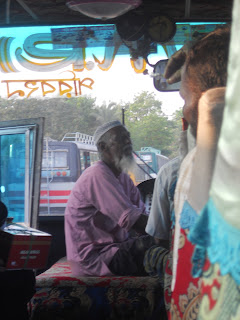
Guy on bus.
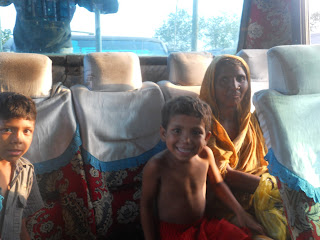
Family on bus, psyched to have the photo op.
Packing into the bus.
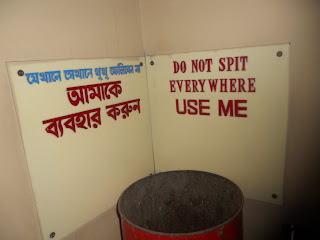
This sign was surprisingly necessary... and totally ignored.
At one point, Mike and I wandererd into an outdoor festival, where we were promptly ushered onto a jury-rigged Ferris wheel. How can you jury rig a Ferris wheel? I don't know, but the whole thing was made of wood and rope, so I was terrified as we spun up and around on it. At another point, we got mobbed at a carnival by a bunch of kids who wanted photos and handshakes with us. A recurring character found us on the street FOUR times (on separate days) to corner us and inquire about the true nature of Powerball (yes, the American lottery). Another time, we stumbled into a Muslim religious lecture, into which we were invited. Obviously, it was in Bengali, so we had no clue what was being said. When we left, my shoes were missing, and it took the whole group of old men about 10 minutes of investigation to figure out that one of their older congregants had "borrowed" them to do his ablutions (ritual cleansing) in the outdoor showers... again, very odd. Nevertheless, he gave them back, so I didn’t have to go barefoot. Such episodes occur constantly in Bangladesh--or, at least, they did for us.
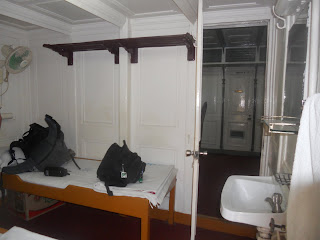
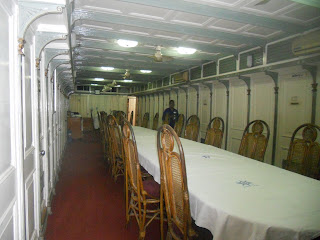
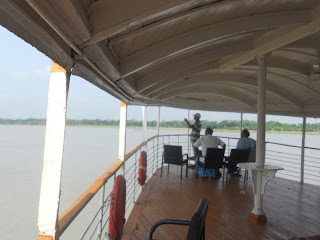
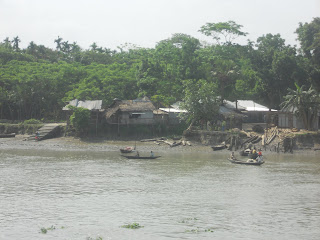
After a few days in Old Dhaka, we decided to go down south to the Khulna Division, an area of the country which Lonely Planet describes as a "frontier" brimming with adventures. We took the Rocket, a steamboat with a paddle wheel. It is supposedly the nicest boat trip in Bangladesh, and it looked like something that got picked up off the Mississippi River circa the 19th century. We had a 1st-class cabin, and the trip lasted a full 24 hours. We met a group of older business partners, and we quickly befriended them and had a great time hanging out with them for the duration of the trip. Being on that boat felt like I had a reached a new plateau in my travel experiences. The scene felt highly remote and anachronistic. It felt like a mix between being Mark Twain, a British colonial officer in India, and a character from Love in the Time of Cholera. We cruised away from the chaos of Dhaka, and within a matter of hours we were floating lazily past jungle villages that looked about as off-the-beaten-path as possible.
Our steamboat cabin and time capsule.
The steamboat's dining room.
Our deck on the boat, with the guys we befriended admiring the view.
A riverside village.
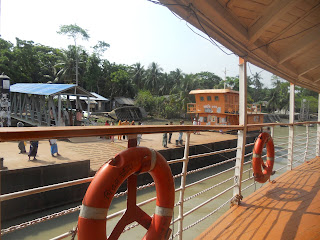
A small port stop along the way.
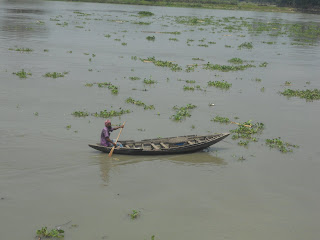
Rowboat on the river.
Mike and I with two of the businessmen, who were extremely kind to us.
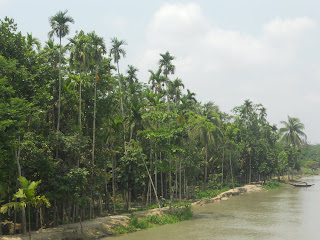
The jungle
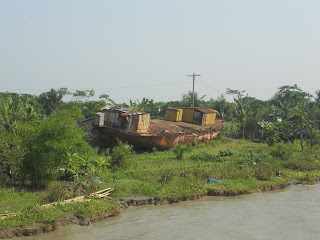
An old boat... maybe shipwrecked?
While I know that some tourists come to this area, I had the distinct feeling that I had finally found a relatively uncharted territory. Even the Lonely Planet guide was sparse on details and left something to be desired. After much confusion about the steamboat's final stop, we were ushered off the boat and had to catch a bus to Bagerhat, a small (though still chaotic) town that boasts some very old mosques.
Our final ferry across the river to catch a bus to Bagerhat.
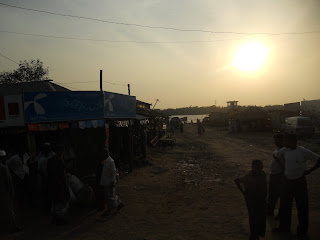
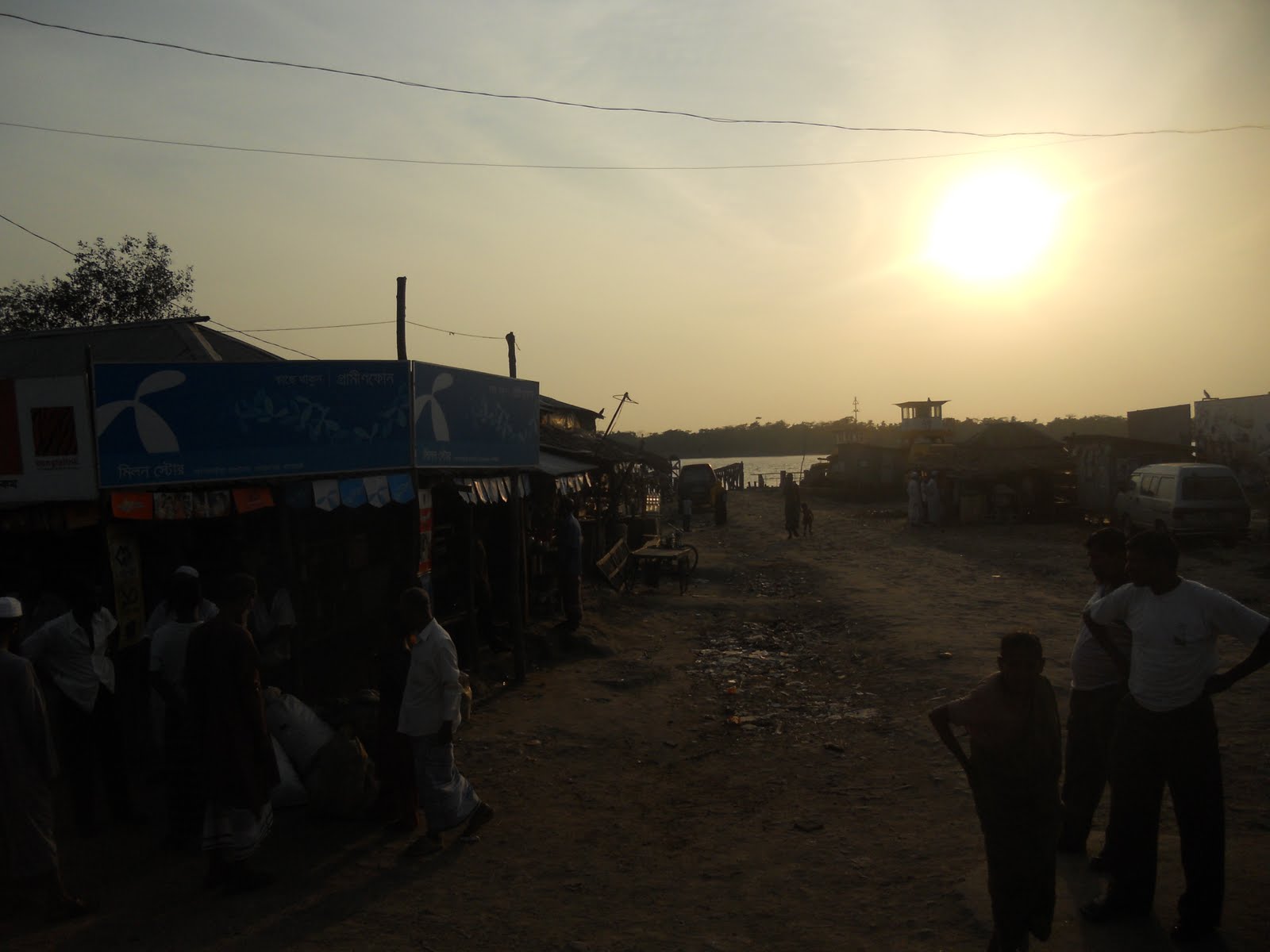
A random village where we caught the bus at sunset.
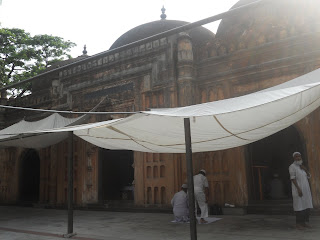
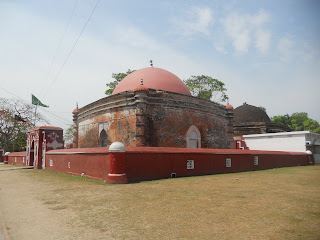
Shait Gumbad Mosque in Bagerhat.
Inside of the Shait Gumbar Mosque.
Another, smaller mosque nearby.
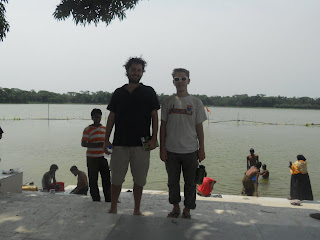
Mike and I, disheveled and exhausted after only 4 days in Bangladesh.
This guy showed us around all morning for free... very eager to hang out with us.
Next stop: Khulna, the capital of the province. In truth, there's not much there, and we only visited in order to catch the Rocket steamboat back to Dhaka. Unfortunately, Lonely Planet was wrong about the boat route, so we ended up having to take a bus, which was quite treacherous. Much like the flight to Hillary-Norgay Airport in Lukla (for our Everest trek), I was gripping my armrests with white knuckles at certain points. Nevertheless, we made it back to Dhaka in one piece, though at times it felt like we might not.
A market in Khulna.
By that time, I was spent. To be honest, I had had enough of Bangladesh. I booked a hotel in Gulshan, the diplomatic district of the city. Here, I was able to sit back, rest, and wait for the Indian embassy to approve my request for a tourist visa. This district of the city was still crazy, but it was much more manageable than Old Dhaka. There were English signs, a good variety of restaurants, and far less traffic. We even saw a handful of other Westerners in this area of the city—though still not very many.
I hope I have not made Bangladesh sound too terrible in this blog. It's really not at all. As I said, the people are friendly, the jungles (outside Dhaka) are gorgeous, and—to say the least—it is a lively place to visit. If I could do it over again, I would, but for shallow reasons. I did not particularly enjoy my time in Bangladesh. It was nice, but my body and brain simply overdosed on the craziness. Nothing runs on time, so everything felt doubly frustrating on top of my already overwhelmed senses. Finally, it took the Indian embassy in Dhaka forever to get my visa (2 weeks and around 10 trips to the embassy), so I felt somewhat trapped by all of the red tape and diplomatic hoops.
But that's exactly why I am glad that I went. I will wear my experiences in Bangladesh like a badge of honor. Paraphrasing and twisting what they say of NYC: "If you can make it here (as a traveler), you can make it anywhere (as a traveler)." From India to Vietnam to Morocco, I have never seen or experienced such a carnival of chaos in my entire life. Even as I ramble in this blog entry, I am painfully aware that I really can never explain what it felt like to be there, and many of you probably just think I am venting or complaining or romanticizing (or all of the above). But Bangladesh really is a place that feels totally foreign and void of tourist traps. Short of places like Somalia, I can't think of anywhere stranger or more difficult to navigate. I take a sort of foolish pride in that. I, like many other travelers, have a strange obsession with getting off the map. It's not easy to do in this day and age. Burma certainly felt that way at times, but Bangladesh brought those feelings of adventure and alienation to a whole new level. At its core, traveling should shove us outside of our normal routine. It should rattle our patience, and it should feel frustrating at times. If I never felt those things while traveling, I probably would need to try harder to get off the beaten path and find something novel and alien. If I travel with the goal of escaping my comfort zone in hopes of finding notable experiences abroad, then Bangladesh has ensured that this journey of mine will exceed all expectations and render this trip an unquestionable success.
Bangladesh also marked the point in the journey where Mike and I split off from one another. It's been nice having a companion, and I am excited to meet up with a few people in the coming weeks, but I am eager to break out on my own as well. Surely, it will change how I experience my trip, and I look forward to it. Until then, I look forward to hearing from you.
"Be well, do good work, and keep in touch."

.