Sunday, May 1, 2011

"Bangladesh! Bangladesh!" or "Car after bus after car after truck..." or "Crazy, but that's how it goes..."

If I had not yet fully earned my stripes as a traveler, all doubts can officially be laid to rest after my visit to Bangladesh. Words don't exist to describe the overwhelming nature of that country, but here are a few that stick out: chaotic, loud, over-crowded, hot, beautiful, confusing, frustrating, dangerous, and strange. Honestly, every one of those adjectives is a gross understatement of what it actually feels like to be a Westerner traveling in Bangladesh.


We arrived in Dhaka, the choked capital city, and promptly booked a room in the sweaty, disorienting Old Dhaka. The first thing you notice about the country is its crippling heat. At over 100 degrees, you begin sweating immediately upon stepping out of the airport. The second thing you notice? The traffic. I have never seen such insanity on the roads. One guy on our flight told us: "You spend four days in Dhaka, three will be spent in traffic." Between pedestrians, bicycle rickshaws, auto rickshaws, cars, motorcycles, buses, and trucks, the roads are constantly gridlocked, yet they somehow move, because an accident seems imminent every couple of seconds. In fact, 32 people die every day on the buses in Bangladesh. After riding on a few of these death trap buses, I'm actually surprised that statistic isn't higher. The Bangladeshi drivers allow for zero wasted space on the roads. In practice, this means that it's not uncommon for an enormous bus to pass a truck full of construction equipment on a two-lane road in the middle of a curve at night as the headlights of oncoming traffic grow disconcertingly larger--all while a motorcycle or two gets elbowed onto the shoulder of the street.
The third thing you notice are the people. Bangladesh does not get a lot of tourists at all. In my first week in the country, I only saw one other Westerner. However, I'm not even sure that she was a Westerner: it was dark, I was walking quickly, and I think I might have been hallucinating from the heat. Even giving her the benefit of the doubt, catching a glimpse of one solitary Westerner in a week is absurdly low. That means that, as Mike and I walked down any given street, we stood out like sore thumbs, and the people of Bangladesh were quite curious and took an overzealous amount of interest in us. It was all friendly—certainly not malicious in the least. Many people showed us around for free, helped us get where we needed to be when the public transit failed us, and wanted to have conversations. They were all very kind, but it gets tiring having to constantly entertain a mob of people who want to shake your hand and exchange contact information.
Walking through the streets of Old Dhaka is like being in a video game obstacle course. There are people EVERYWHERE. You constantly have to keep an eye on the sidewalk, as you might step into one of the weak spots and fall into the mucky sewage. Beware of the large sheets of metal being hauled in and out of storefronts, as they often come dangerously close to ramming into heads. Meanwhile, make sure you don't get your toes run over by the bicycle rickshaws that turn reckless corners. Furthermore, there are usually some (admittedly tragic and heartbreaking) beggars crawling on the sidewalk. Meanwhile, nobody speaks English, which is rare no matter where you are in the world. For a soundtrack, there are car horns and blaring South Asian music, usually with the abrasive sound of somebody sawing through wood somewhere. None of these things may seem insurmountable—after all, I suppose I did make it out of Old Dhaka alive. However, when those things are experienced together in such oppressively hot temperatures, it feels as though your senses are getting the shit kicked out of them. Indeed, Bangladesh successfully blew all of my circuits, and I am still trying to reboot from it.
Crazy crowds.
Guy on bus.
Family on bus, psyched to have the photo op.
Packing into the bus.
This sign was surprisingly necessary... and totally ignored.
At one point, Mike and I wandererd into an outdoor festival, where we were promptly ushered onto a jury-rigged Ferris wheel. How can you jury rig a Ferris wheel? I don't know, but the whole thing was made of wood and rope, so I was terrified as we spun up and around on it. At another point, we got mobbed at a carnival by a bunch of kids who wanted photos and handshakes with us. A recurring character found us on the street FOUR times (on separate days) to corner us and inquire about the true nature of Powerball (yes, the American lottery). Another time, we stumbled into a Muslim religious lecture, into which we were invited. Obviously, it was in Bengali, so we had no clue what was being said. When we left, my shoes were missing, and it took the whole group of old men about 10 minutes of investigation to figure out that one of their older congregants had "borrowed" them to do his ablutions (ritual cleansing) in the outdoor showers... again, very odd. Nevertheless, he gave them back, so I didn’t have to go barefoot. Such episodes occur constantly in Bangladesh--or, at least, they did for us.
After a few days in Old Dhaka, we decided to go down south to the Khulna Division, an area of the country which Lonely Planet describes as a "frontier" brimming with adventures. We took the Rocket, a steamboat with a paddle wheel. It is supposedly the nicest boat trip in Bangladesh, and it looked like something that got picked up off the Mississippi River circa the 19th century. We had a 1st-class cabin, and the trip lasted a full 24 hours. We met a group of older business partners, and we quickly befriended them and had a great time hanging out with them for the duration of the trip. Being on that boat felt like I had a reached a new plateau in my travel experiences. The scene felt highly remote and anachronistic. It felt like a mix between being Mark Twain, a British colonial officer in India, and a character from Love in the Time of Cholera. We cruised away from the chaos of Dhaka, and within a matter of hours we were floating lazily past jungle villages that looked about as off-the-beaten-path as possible.
Our steamboat cabin and time capsule.
The steamboat's dining room.
Our deck on the boat, with the guys we befriended admiring the view.
A riverside village.
A small port stop along the way.
Rowboat on the river.
Mike and I with two of the businessmen, who were extremely kind to us.
The jungle
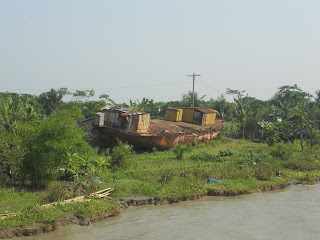
An old boat... maybe shipwrecked?
While I know that some tourists come to this area, I had the distinct feeling that I had finally found a relatively uncharted territory. Even the Lonely Planet guide was sparse on details and left something to be desired. After much confusion about the steamboat's final stop, we were ushered off the boat and had to catch a bus to Bagerhat, a small (though still chaotic) town that boasts some very old mosques.
Our final ferry across the river to catch a bus to Bagerhat.
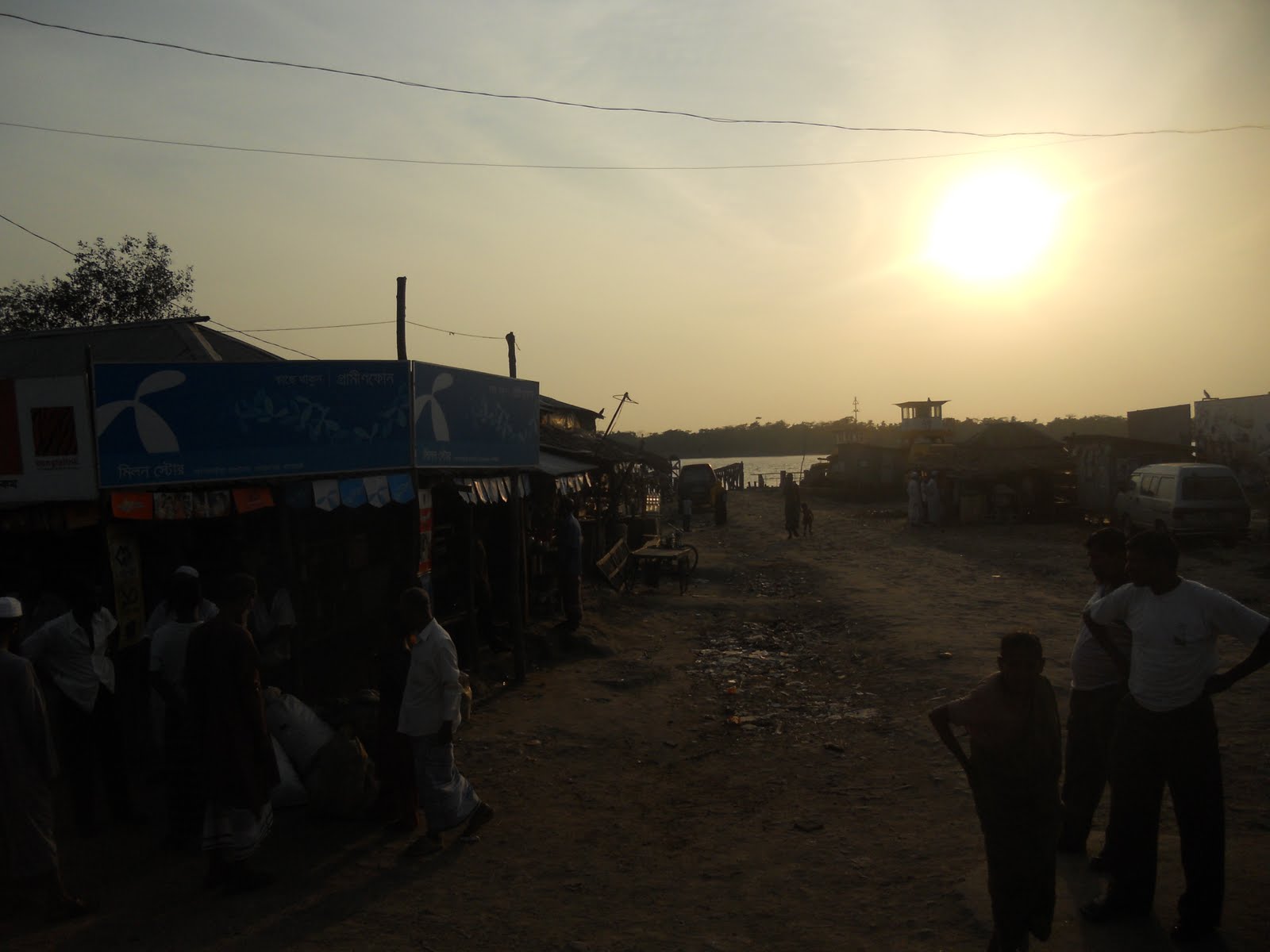
A random village where we caught the bus at sunset.
Shait Gumbad Mosque in Bagerhat.
Inside of the Shait Gumbar Mosque.
Another, smaller mosque nearby.
Mike and I, disheveled and exhausted after only 4 days in Bangladesh.
This guy showed us around all morning for free... very eager to hang out with us.
Next stop: Khulna, the capital of the province. In truth, there's not much there, and we only visited in order to catch the Rocket steamboat back to Dhaka. Unfortunately, Lonely Planet was wrong about the boat route, so we ended up having to take a bus, which was quite treacherous. Much like the flight to Hillary-Norgay Airport in Lukla (for our Everest trek), I was gripping my armrests with white knuckles at certain points. Nevertheless, we made it back to Dhaka in one piece, though at times it felt like we might not.
A market in Khulna.
By that time, I was spent. To be honest, I had had enough of Bangladesh. I booked a hotel in Gulshan, the diplomatic district of the city. Here, I was able to sit back, rest, and wait for the Indian embassy to approve my request for a tourist visa. This district of the city was still crazy, but it was much more manageable than Old Dhaka. There were English signs, a good variety of restaurants, and far less traffic. We even saw a handful of other Westerners in this area of the city—though still not very many.
I hope I have not made Bangladesh sound too terrible in this blog. It's really not at all. As I said, the people are friendly, the jungles (outside Dhaka) are gorgeous, and—to say the least—it is a lively place to visit. If I could do it over again, I would, but for shallow reasons. I did not particularly enjoy my time in Bangladesh. It was nice, but my body and brain simply overdosed on the craziness. Nothing runs on time, so everything felt doubly frustrating on top of my already overwhelmed senses. Finally, it took the Indian embassy in Dhaka forever to get my visa (2 weeks and around 10 trips to the embassy), so I felt somewhat trapped by all of the red tape and diplomatic hoops.
But that's exactly why I am glad that I went. I will wear my experiences in Bangladesh like a badge of honor. Paraphrasing and twisting what they say of NYC: "If you can make it here (as a traveler), you can make it anywhere (as a traveler)." From India to Vietnam to Morocco, I have never seen or experienced such a carnival of chaos in my entire life. Even as I ramble in this blog entry, I am painfully aware that I really can never explain what it felt like to be there, and many of you probably just think I am venting or complaining or romanticizing (or all of the above). But Bangladesh really is a place that feels totally foreign and void of tourist traps. Short of places like Somalia, I can't think of anywhere stranger or more difficult to navigate. I take a sort of foolish pride in that. I, like many other travelers, have a strange obsession with getting off the map. It's not easy to do in this day and age. Burma certainly felt that way at times, but Bangladesh brought those feelings of adventure and alienation to a whole new level. At its core, traveling should shove us outside of our normal routine. It should rattle our patience, and it should feel frustrating at times. If I never felt those things while traveling, I probably would need to try harder to get off the beaten path and find something novel and alien. If I travel with the goal of escaping my comfort zone in hopes of finding notable experiences abroad, then Bangladesh has ensured that this journey of mine will exceed all expectations and render this trip an unquestionable success.
Bangladesh also marked the point in the journey where Mike and I split off from one another. It's been nice having a companion, and I am excited to meet up with a few people in the coming weeks, but I am eager to break out on my own as well. Surely, it will change how I experience my trip, and I look forward to it. Until then, I look forward to hearing from you.
"Be well, do good work, and keep in touch."

.

Thursday, April 14, 2011

"I've been out walking..." or "Such great heights" or "If you want to view paradise, simply look around and view it."

The reason most tourists come to Nepal is to do some sort of nature trek. After all, the largest mountains in the world reside along Nepal's northern border. While in Thamel (the tourist district of Kathmandu), it seems as though everybody is either gearing up for a long trek or recently returning from one. With this in mind, it seemed a little ridiculous that, adding up my collective time spent in Nepal, I have traveled in the country for almost 2 months and have never seen the hugeness of the Himalayas--for that matter, I had never really gotten out of the polluted streets of Kathmandu. So, when an adventurous traveler from New Zealand described his recent trek to Everest Base Camp over breakfast, Mike and I promptly decided to suck up our laziness and do it.

The Everest Base Camp trek is one of the most popular in Nepal, culminating with--you guessed it--stunning views of the notoriously tallest mountain on the planet. The stranger from New Zealand assured us that we did not need a guide or a porter. In fact, he said we probably would not need a map. Fortunately, we ignored this last bit of advice, but he was certainly right about not hiring any help. Doing it by ourselves made the journey far more enriching and adventuresome.

The trek began with a somewhat treacherous flight to Lukla, a small village/town on the side of a mountain way east of Kathmandu. You fly in on a 19-passenger prop plane, and you land in Tenzing-Hillary Airport, named for the two men credited as the first to summit Mount Everest in the 1950s. The airport itself is quite the spectacle. The world's highest airport, Tenzing-Hillary's runway is disconcertingly short, and--even worse--is on a highly noticeable angle (about 30 degrees, I'd guess). As you approach Lukla, you can see the face of a mountain through the cockpit windshield. After about 40 minutes of mountain turbulence, I had pretty much resigned myself to the fact that I was just going to smash right into the side of that mountain. Miraculously, though, we landed safely on the inclined runway. (I say "miraculously" only because I'm a baby. In fact, plane crashes are still pretty rare there. Even so, it was definitely the most tense I have ever felt while flying, and I don't typically have that phobia.)

Anyway, there is really only one reason to go to that region of Nepal as a tourist: trekking. All the locals know it, so they kindly direct you wherever you need to be, particularly when you accidentally stray from the path, which is usually pretty well defined anyway. I will not waste everyone's time by recounting the journey village by village. If you want to look up the individual communities we lodged in, our itinerary was as follows: Lukla, Phakding, Namche Bazaar, Tengboche, Dingboche, Dughla, Gorak Shep, and then back down via Pheriche. All in all, the quest took a whopping 11 days, the first seven of which were a steady uphill climb.

But before I get to the photos, I want to mention the Sherpas with whom we stayed on the trek. In all of the villages, the ethnicity of the locals was predominantly Sherpa, the well known ethnic group of Buddhists who have strong ties to Tibet. All of the villagers operate a lodge, which is to say that they all just let foreigners stay in their house for a small fee (about $1.50 a night) as long as you eat their cooking. The food was a bit expensive because it all has to be lugged up the mountains by porters for days on end (again, there are no roads out there). However, the cooking was worth it, and the company of the Sherpas was even better. Whether it was the lodge owners themselves, random villagers, or the porters and guides of other trekking groups, the Sherpas were extremely friendly and generally had wonderful senses of humor. As I felt in Burma--indeed, as I often feel while traveling--I was overwhelmed and pleasantly surprised by the kindness and hospitality shown to us by the local strangers.

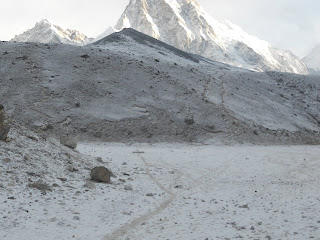
Finally, the star attraction of the trek: the views. With each day, the terrain got less and less lush, more and more desolate. It became cold, until at the top the water in the (Eastern-style) toilets would freeze overnight. However, with every step we continued deeper and deeper into the heart of the Himalayas, possibly the most breathtaking mountain range in the entire world. The trek was supposed to culminate with a trip to Everest Base Camp, where mountaineers begin their ascents to the beastly mountain's summit. However, I decided to forego that (there are no views from EBC) in favor of making it to the summit of a nearby, though notably less impressive, mountain called Kala Patthar, which supposedly boasts some of the best available views of the mountain range. From the top, I could see Everest Base Camp far below on the infamous Khumbu Glacier, and the whole scene was quiet and stunning. It was quite difficult to make it to the top, and I was sweating and panting when I finally made it. Even though Kala Patthar looks like a mere hill compared to its mammoth neighbors, make no mistake: the summit I reached was over 18,000 feet, which--for perspective--is higher than several of the Seven Summits. It was no easy task, but the views were definitely worth it. Here is a random array of photos from the trip:
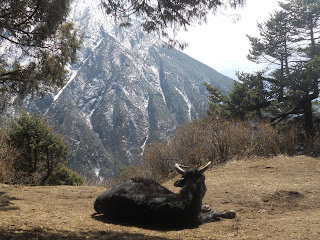
Hanging out.
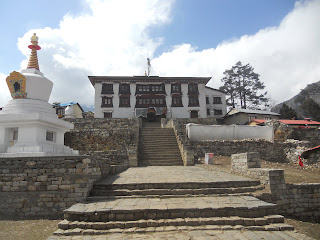
Hilltop Monastery at Tengboche.
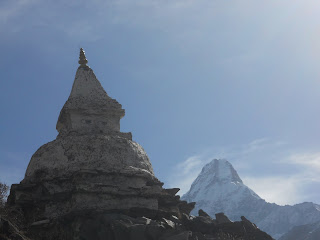
Buddhist statue on the trail.
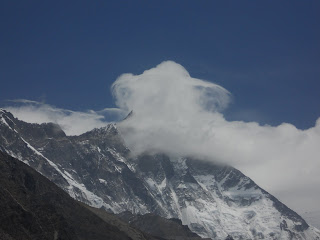
Cool windy cloud along the way.
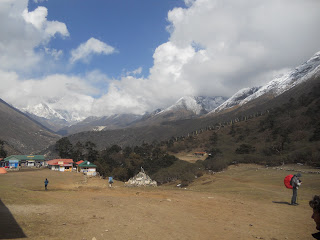
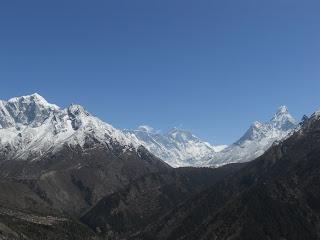
The view from Tengboche, around the 1/2-way point.
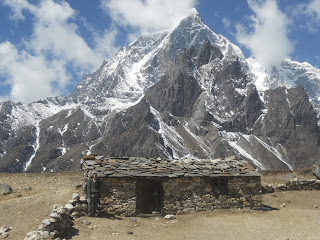
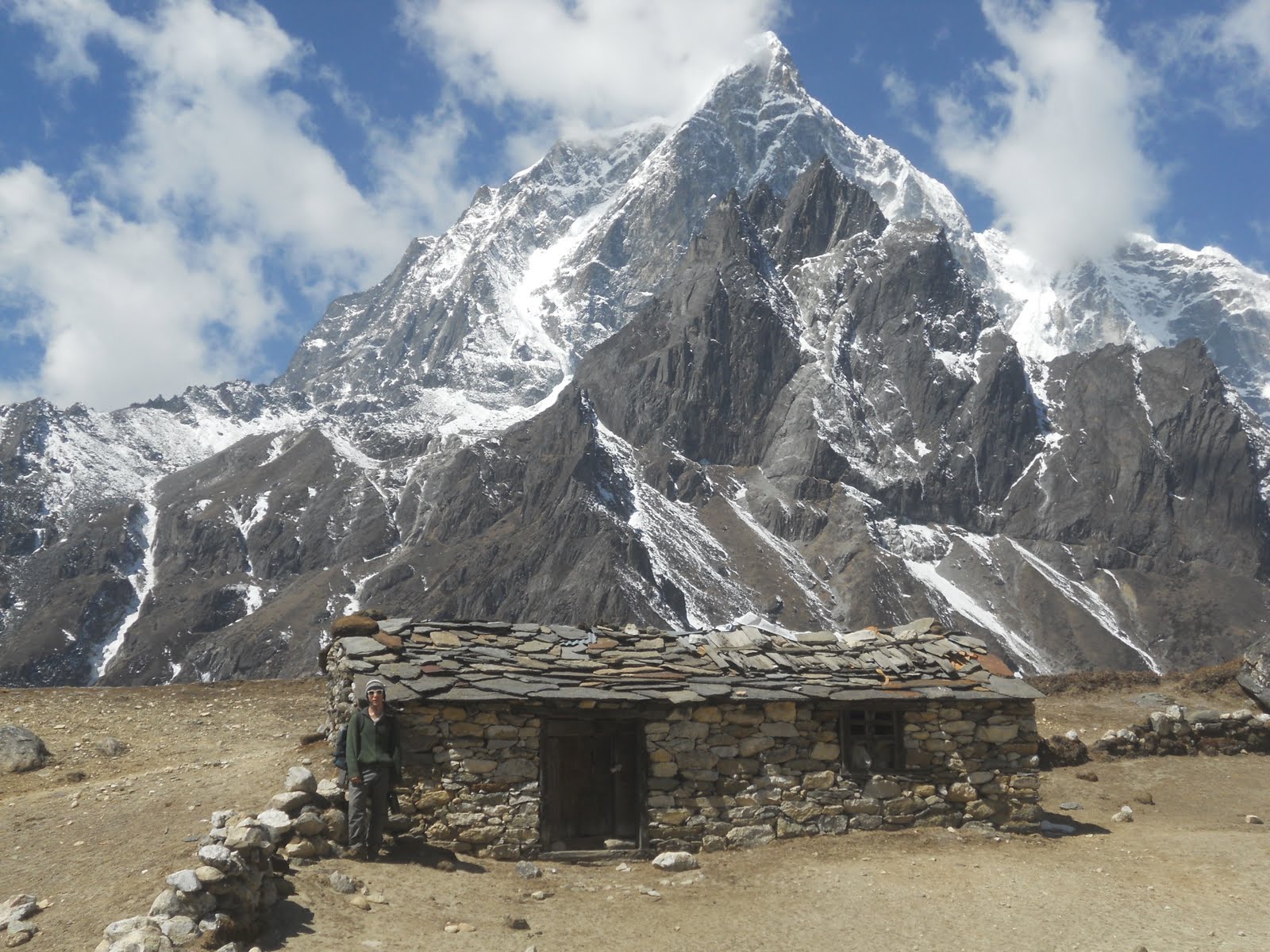
A stone hut, as the trail gets more desolate.
The deceptively whimpy summit of Kala Patthar.


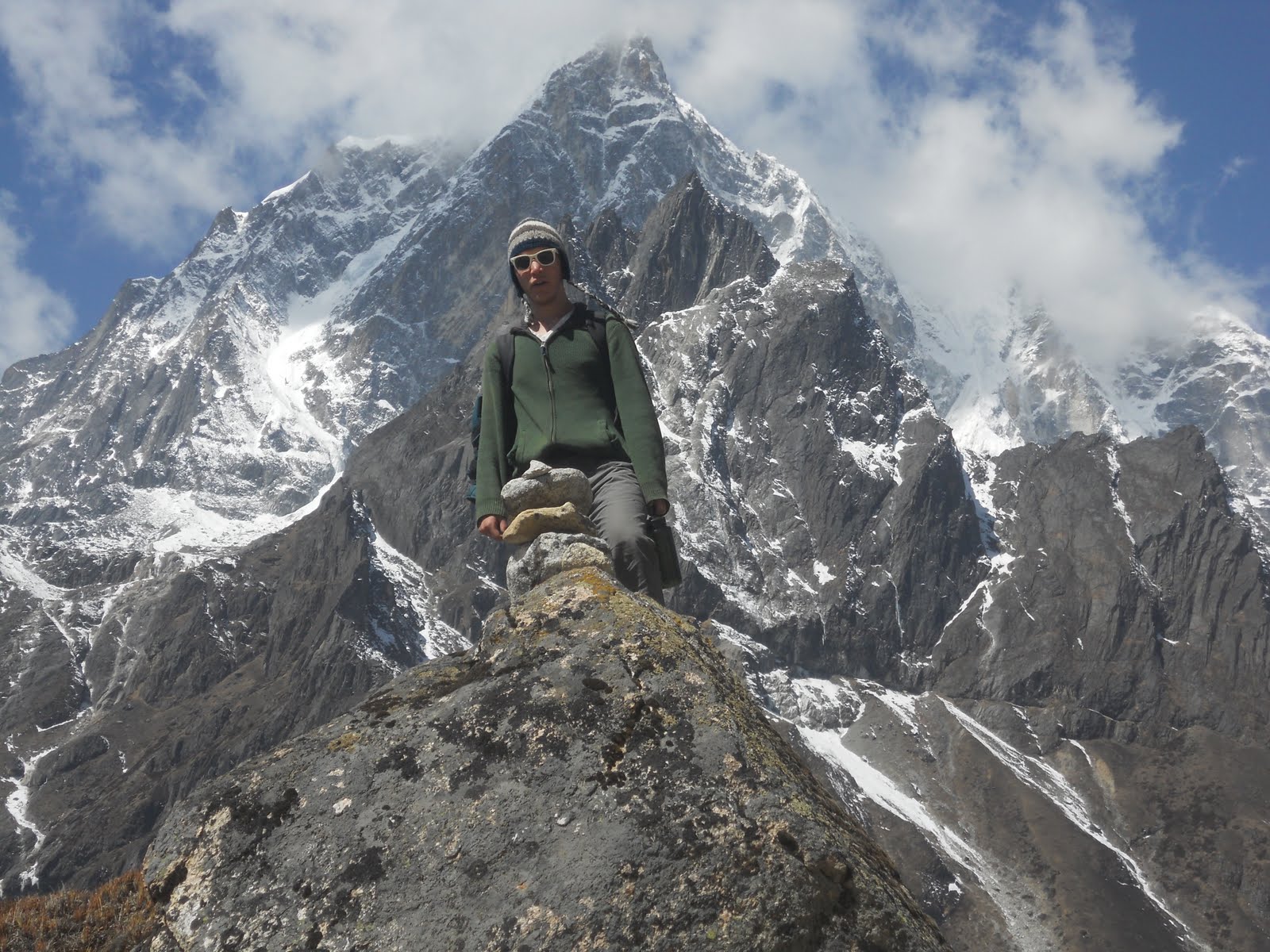
The Himalayas.
Another great view.
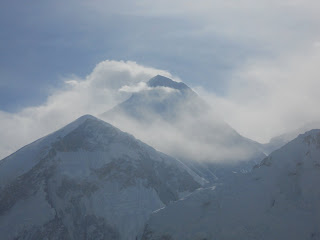
Mount Everest, behind a cool veil of clouds, as seen from Kala Patthar.
The trek was absolutely amazing, though I am definitely glad to be down from the mountains and back into the warm weather. When we arrived back in Kathmandu, we went to Bina's school to pick up our bags and say our goodbyes. It was really a shame parting ways with her and her family, especially because I don't know when I will be fortunate enough to return to Kathmandu. After force-feeding us one last gorging meal, Bina bid us farewell, and we went on our way.

Tomorrow, we trade in the cold mountain air of high-altitude Nepal for a totally different scene: the stiff heat of Bangladesh. I don't quite know what to expect from Bangladesh, but we've been reading a lot of really cool, interesting things about it. As always, I am very excited. Until then, today (the 15th) is the Nepali New Year, so the mood is festive in Kathmandu. I'll update the blog again soon. All the best!

"Be well, do good work, and keep in touch."


.

Wednesday, March 30, 2011

"Let me stand next to your fire" or "'Come in,' she said, 'I'll give you shelter from the storm.'"

When I visited Kathmandu in the summer of 2008, I volunteered at a daycare center and school. The woman who founded and runs the operation is Bina, a remarkabley inspiring, savvy, and relentlessly hospitable person. Before leaving Nepal my first time, she assured me that I always had a free place to stay if ever I returned. Since getting back from Dubai, Mike and I have taken her up on that offer and have been sleeping in the main hall of the daycare center, and it has been wonderful.

Before I discuss Bina and the school, though, I want to mention our afternoon visit to Pashupatinath, the most sacred Hindu temple in Kathmandu (probably in all of Nepal). Unfortunately, non-Hindus are not allowed to enter the temple itself, but there is plenty to see and experience around the grounds. There are Sadhus (religious ascetics), adorned in outlandish garb and decorated with colorful paint. Some of these are sincere spiritual seekers, but many of them are more interested in earning an extra buck posing for tourist photos. Regardless, they add to the out-of-this-world vibe that Pashupatinath emits. In addition to the Sadhus, there are laypersons around enjoying their afternoons and worshipping at any of the many Hindu shrines that dot the complex.
Sadhus sitting around the temple grounds.

Meditating Sadhu.
Resting Sadhus.
To be honest, I wanted to visit Pashupatinath for a very specific reason: open-air cremation ceremonies. I know that sounds awfully dark (and perhaps a bit twisted), but I have always had a reverential fascination with Hindu funerals and cremation rites. Allen Ginsberg, I once read, used to spend all of his days in India watching these somber ceremonies occur on the banks of the Ganges. It was his favorite thing to do in the country. He found it peaceful and awe-inspiring. I don't know what I expected from the cremation rituals, but I knew that I wanted to witness one while in South Asia. The temple of Pashupatinath sits along the dirty Bagmati River. Because Nepal is still a society riddled with class/caste distinctions, only certain people can be cremated in the area right beside the temple. The poorer, more common people hold their ceremonies about 200 feet downstream, which is where most of them take place.

On one side of the river, there are about 5 cement platforms jutting out over the shallow, polluted river. Throughout the course of an hour or so, we saw 4 cremations in progress. When a funeral occurs, a pyre is constructed using big logs. Then, the lifeless body, wrapped in cloth, is laid upon the pyre and covered with dry straw. After that, with a crowd of family and friends around, the bottom of the logs are set ablaze. Smoke billows out from the stack, and the people look at it sullenly until they all eventually trickle away. After a little while, the pyre is reduced to a smoldering campfire containing ashen human remains, which are then swept into the Bagmati River.

I am not going to pretend that I had some life-altering revalation while witnessing the cremations. However, watching the funerals from the opposite side of the river, I could not help but feel a sense of somber appreciation. I have always liked the idea of cremation--ashes to ashes, dust to dust, et cetera, et cetera. There is something wonderful about the way in which cremation expedites this process of returning us to unconcious matter. Eventually, it happens to everyone. At the risk of sounding crass, we all ultimately become worm food and fertilizer. Regardless of one's religious (or non-religious) opinion about an eternal soul, nobody can deny this fact about the physical body. For this reason, I have never fully understood things like embalming fluids and lacquered caskets. Perhaps this is why I found the Hindu cremation rites so moving--no frills, no illusions. In the burning funeral pyres, there exists an inherent acceptance of one's body returning to a state of ash and dust, so to speak. I could ramble about this forever, and that's a blog entry for another day. In any event, it was a really beautiful thing to see.
Pre-cremation funeral pyre all prepared.
 

Early in the blaze.

Cremation with the Bagmati River below.
As I mentioned in the first paragraph of this entry, Mike and I have been staying at a school and daycare center. The organization has been very close to my heart since I first volunteered here in 2008. Basically, the center offers a safe, educational, fun, and (most importantly) free place for parents to leave their children while they go to work. Often, the children come from single-mother homes in which the father is either dead, drunk, abusive, absent, or otherwise not in the picture. This creates a situation in which women must do manual labor to barely make ends meet (at best). However, they cannot get any work with infants and toddlers tied to their backs, and thusly the cycle of poverty perpetuates. Bina, the founder of the organization, used to work at an orphanage in Kathmandu, and she saw many mothers who would plead for the orphanage to take their children only for a short time so that they could earn some money for food. This spawned the initial idea for a free daycare center, and it has been hugely successful ever since. Several newspapers and magazines in Nepal have done well deserved feature stories on Bina, for she is an inspiring and relentlessly compassionate individual.
Play time at the school.

The recently built addition.
Thanks to the tireless work of Bina and the support of donors from all over the world, the school has undergone some major changes since I was here in 2008. It has doubled in size. They have hired three teachers to implement "real" lesson plans for early education. They offer a nutritional meal to the children every day. However, Bina's charitable days never really end. Staying at her home is like being in the most ecclectic boarding house imaginable. First, there is her family--husband, daughter (Saluna), and son (Ashish). Then, there is Nan, one of the daycare workers, and her son (Rem). Additionally, there are the constant foreign volunteers--at the moment, there are two Americans (Mike and myself), one Danish girl, and two Dutch volunteers all working at the school. Beyond this strange mix of people, there is a young orphan girl who Bina's family has taken in. They have not officially adopted her (I don't think), but she sleeps here and is treated like one of the family. Finally, it is not uncommon for one or two of the children to stay until the late hours of the night, when they can finally be picked up by a parent or sibling. In truth, I never REALLY know who is related and who is not. The cast is constantly changing, and everyone who stays here is treated as family, including the foreign volunteers. We are fed 3 (absurdly large) meals every day, and we are given a comfortable place to sleep in spite of the already crowded, boarding-house feel of the home. What's more, we are only expected to help out around the school in return. I often feel guilty because I know that, even though we are supposed to be the do-gooders, we can never repay the kindness shown to us by Bina and her family. A few hours of playing with kids each day has not earned us the free room and board.

At the end of the day, the organization is about the kids. When I first visited here, the small school was just a drop-off place for children with no place else to go. While it still serves that important social purpose today, it has also transformed into a fully functional daycare and early education center. It's truly amazing what Bina has done. Having returned, I can see the difference she has made in the lives of specific children. Bina packs pounds onto undernourished children. She patiently helps students spell words in English. She has an almost unbelievable rapport with the younger children (ages 0-3), who respect her and love her dearly. Bina has a real passion for helping children, and in doing so she purposefully helps their parents escape the shackles of poverty. The plan is perfect in its simplicity, and it works. It is impossible not to be touched by the positive effects of Bina's efforts. I have never seen such adorable, happy children from such strained backgrounds:


A bi-weekly music class that Bina has arranged with a local musician.


The school depends on outside support, and it is a registered non-profit. If you would like to donate, please let me know. I can assure you that your money will be allocated honestly and wisely on food, scholarships (to help the children go to private schools when they come of age), books, and equipment. I can send literature to anyone who requests it. If you happen to have a slightly heavy wallet and a desire to help an organization that makes a real, measurable difference, this is a great way to do that. Bina has learned to stretch donations as far as they will go, so anything and everything helps a great deal. Let me know. (Sorry for the Public Service Announcement. I got carried away, but it is a very worthy cause if you're in the market.)

That's all for now. Barring any weather-related problems, Mike and I will be doing some extended trekking starting next week, which I'm very excited about. It's supposed to be some of the most beautiful scenery in the Himalayas, so hopefully the weather will permit us to go. Until then, I look forward to hearing from all of you.

"Be well, do good work, and keep in touch."


.