Thursday, April 14, 2011

"I've been out walking..." or "Such great heights" or "If you want to view paradise, simply look around and view it."

The reason most tourists come to Nepal is to do some sort of nature trek. After all, the largest mountains in the world reside along Nepal's northern border. While in Thamel (the tourist district of Kathmandu), it seems as though everybody is either gearing up for a long trek or recently returning from one. With this in mind, it seemed a little ridiculous that, adding up my collective time spent in Nepal, I have traveled in the country for almost 2 months and have never seen the hugeness of the Himalayas--for that matter, I had never really gotten out of the polluted streets of Kathmandu. So, when an adventurous traveler from New Zealand described his recent trek to Everest Base Camp over breakfast, Mike and I promptly decided to suck up our laziness and do it.

The Everest Base Camp trek is one of the most popular in Nepal, culminating with--you guessed it--stunning views of the notoriously tallest mountain on the planet. The stranger from New Zealand assured us that we did not need a guide or a porter. In fact, he said we probably would not need a map. Fortunately, we ignored this last bit of advice, but he was certainly right about not hiring any help. Doing it by ourselves made the journey far more enriching and adventuresome.

The trek began with a somewhat treacherous flight to Lukla, a small village/town on the side of a mountain way east of Kathmandu. You fly in on a 19-passenger prop plane, and you land in Tenzing-Hillary Airport, named for the two men credited as the first to summit Mount Everest in the 1950s. The airport itself is quite the spectacle. The world's highest airport, Tenzing-Hillary's runway is disconcertingly short, and--even worse--is on a highly noticeable angle (about 30 degrees, I'd guess). As you approach Lukla, you can see the face of a mountain through the cockpit windshield. After about 40 minutes of mountain turbulence, I had pretty much resigned myself to the fact that I was just going to smash right into the side of that mountain. Miraculously, though, we landed safely on the inclined runway. (I say "miraculously" only because I'm a baby. In fact, plane crashes are still pretty rare there. Even so, it was definitely the most tense I have ever felt while flying, and I don't typically have that phobia.)

Anyway, there is really only one reason to go to that region of Nepal as a tourist: trekking. All the locals know it, so they kindly direct you wherever you need to be, particularly when you accidentally stray from the path, which is usually pretty well defined anyway. I will not waste everyone's time by recounting the journey village by village. If you want to look up the individual communities we lodged in, our itinerary was as follows: Lukla, Phakding, Namche Bazaar, Tengboche, Dingboche, Dughla, Gorak Shep, and then back down via Pheriche. All in all, the quest took a whopping 11 days, the first seven of which were a steady uphill climb.

But before I get to the photos, I want to mention the Sherpas with whom we stayed on the trek. In all of the villages, the ethnicity of the locals was predominantly Sherpa, the well known ethnic group of Buddhists who have strong ties to Tibet. All of the villagers operate a lodge, which is to say that they all just let foreigners stay in their house for a small fee (about $1.50 a night) as long as you eat their cooking. The food was a bit expensive because it all has to be lugged up the mountains by porters for days on end (again, there are no roads out there). However, the cooking was worth it, and the company of the Sherpas was even better. Whether it was the lodge owners themselves, random villagers, or the porters and guides of other trekking groups, the Sherpas were extremely friendly and generally had wonderful senses of humor. As I felt in Burma--indeed, as I often feel while traveling--I was overwhelmed and pleasantly surprised by the kindness and hospitality shown to us by the local strangers.

Finally, the star attraction of the trek: the views. With each day, the terrain got less and less lush, more and more desolate. It became cold, until at the top the water in the (Eastern-style) toilets would freeze overnight. However, with every step we continued deeper and deeper into the heart of the Himalayas, possibly the most breathtaking mountain range in the entire world. The trek was supposed to culminate with a trip to Everest Base Camp, where mountaineers begin their ascents to the beastly mountain's summit. However, I decided to forego that (there are no views from EBC) in favor of making it to the summit of a nearby, though notably less impressive, mountain called Kala Patthar, which supposedly boasts some of the best available views of the mountain range. From the top, I could see Everest Base Camp far below on the infamous Khumbu Glacier, and the whole scene was quiet and stunning. It was quite difficult to make it to the top, and I was sweating and panting when I finally made it. Even though Kala Patthar looks like a mere hill compared to its mammoth neighbors, make no mistake: the summit I reached was over 18,000 feet, which--for perspective--is higher than several of the Seven Summits. It was no easy task, but the views were definitely worth it. Here is a random array of photos from the trip:
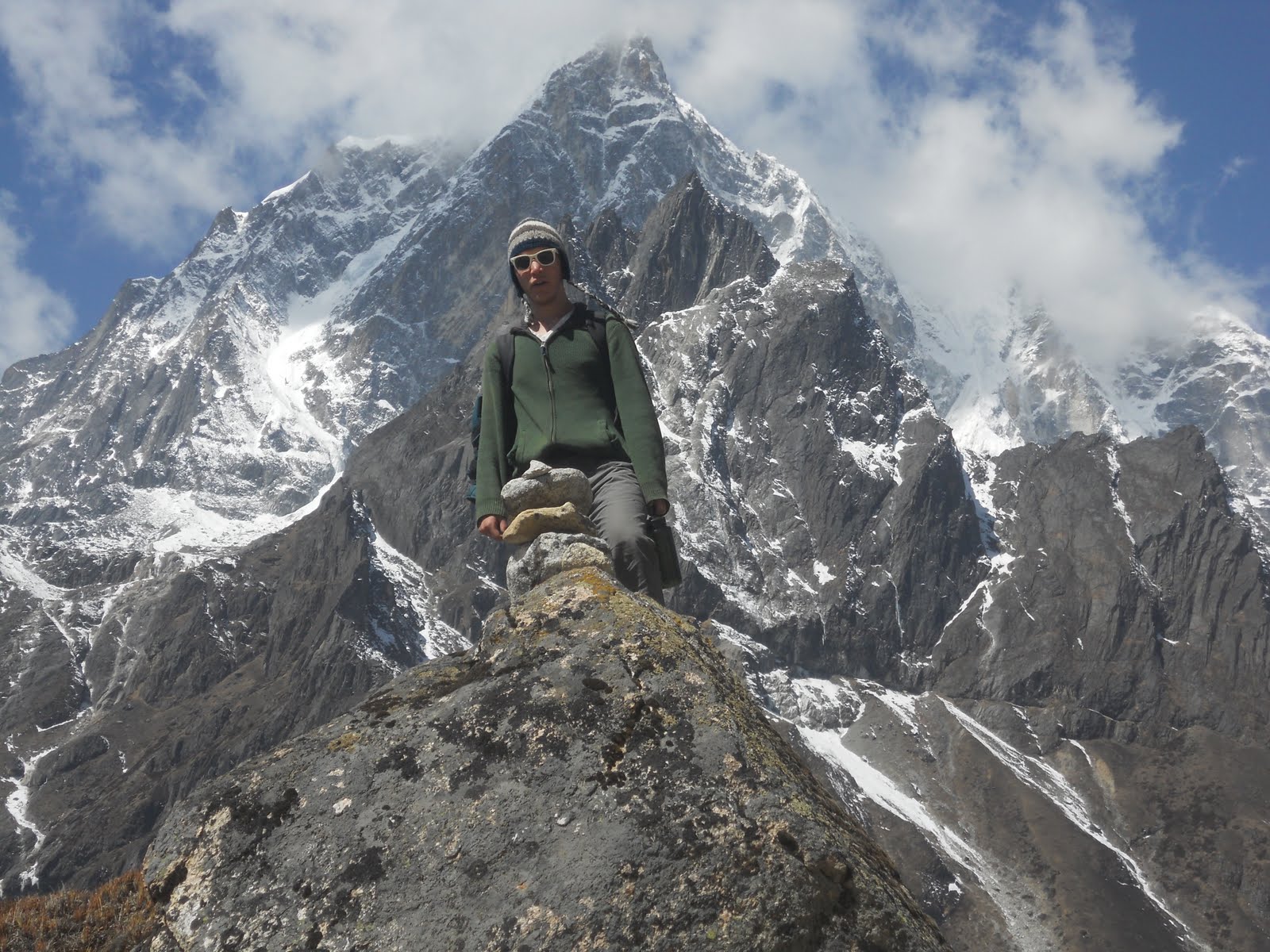
Hanging out.
Hilltop Monastery at Tengboche.
Buddhist statue on the trail.
Cool windy cloud along the way.
The view from Tengboche, around the 1/2-way point.
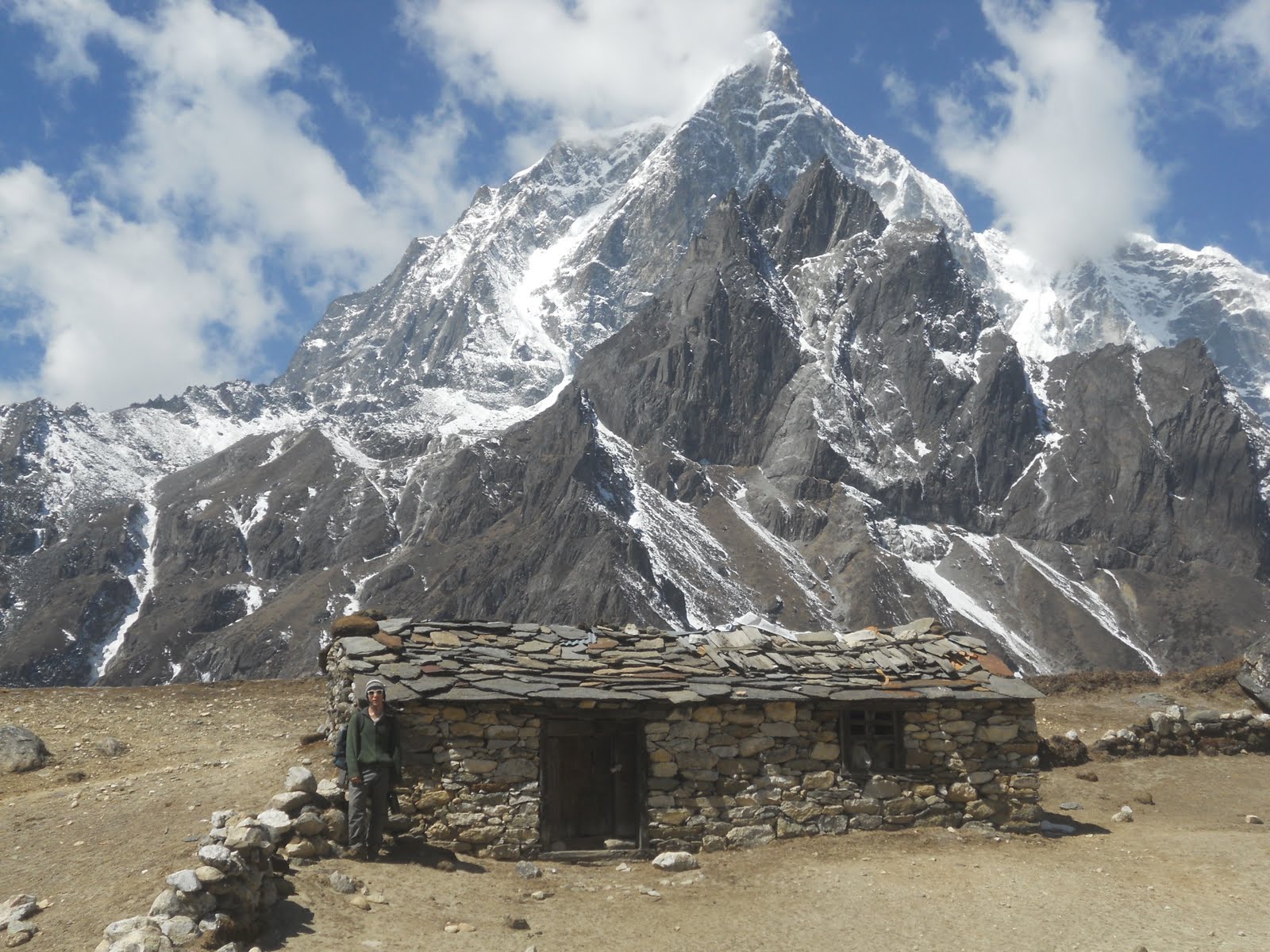
A stone hut, as the trail gets more desolate.
The deceptively whimpy summit of Kala Patthar.


The Himalayas.
Another great view.
Mount Everest, behind a cool veil of clouds, as seen from Kala Patthar.
The trek was absolutely amazing, though I am definitely glad to be down from the mountains and back into the warm weather. When we arrived back in Kathmandu, we went to Bina's school to pick up our bags and say our goodbyes. It was really a shame parting ways with her and her family, especially because I don't know when I will be fortunate enough to return to Kathmandu. After force-feeding us one last gorging meal, Bina bid us farewell, and we went on our way.

Tomorrow, we trade in the cold mountain air of high-altitude Nepal for a totally different scene: the stiff heat of Bangladesh. I don't quite know what to expect from Bangladesh, but we've been reading a lot of really cool, interesting things about it. As always, I am very excited. Until then, today (the 15th) is the Nepali New Year, so the mood is festive in Kathmandu. I'll update the blog again soon. All the best!

"Be well, do good work, and keep in touch."


.

Wednesday, March 30, 2011

"Let me stand next to your fire" or "'Come in,' she said, 'I'll give you shelter from the storm.'"

When I visited Kathmandu in the summer of 2008, I volunteered at a daycare center and school. The woman who founded and runs the operation is Bina, a remarkabley inspiring, savvy, and relentlessly hospitable person. Before leaving Nepal my first time, she assured me that I always had a free place to stay if ever I returned. Since getting back from Dubai, Mike and I have taken her up on that offer and have been sleeping in the main hall of the daycare center, and it has been wonderful.

Before I discuss Bina and the school, though, I want to mention our afternoon visit to Pashupatinath, the most sacred Hindu temple in Kathmandu (probably in all of Nepal). Unfortunately, non-Hindus are not allowed to enter the temple itself, but there is plenty to see and experience around the grounds. There are Sadhus (religious ascetics), adorned in outlandish garb and decorated with colorful paint. Some of these are sincere spiritual seekers, but many of them are more interested in earning an extra buck posing for tourist photos. Regardless, they add to the out-of-this-world vibe that Pashupatinath emits. In addition to the Sadhus, there are laypersons around enjoying their afternoons and worshipping at any of the many Hindu shrines that dot the complex.
Sadhus sitting around the temple grounds.

Meditating Sadhu.
Resting Sadhus.
To be honest, I wanted to visit Pashupatinath for a very specific reason: open-air cremation ceremonies. I know that sounds awfully dark (and perhaps a bit twisted), but I have always had a reverential fascination with Hindu funerals and cremation rites. Allen Ginsberg, I once read, used to spend all of his days in India watching these somber ceremonies occur on the banks of the Ganges. It was his favorite thing to do in the country. He found it peaceful and awe-inspiring. I don't know what I expected from the cremation rituals, but I knew that I wanted to witness one while in South Asia. The temple of Pashupatinath sits along the dirty Bagmati River. Because Nepal is still a society riddled with class/caste distinctions, only certain people can be cremated in the area right beside the temple. The poorer, more common people hold their ceremonies about 200 feet downstream, which is where most of them take place.

On one side of the river, there are about 5 cement platforms jutting out over the shallow, polluted river. Throughout the course of an hour or so, we saw 4 cremations in progress. When a funeral occurs, a pyre is constructed using big logs. Then, the lifeless body, wrapped in cloth, is laid upon the pyre and covered with dry straw. After that, with a crowd of family and friends around, the bottom of the logs are set ablaze. Smoke billows out from the stack, and the people look at it sullenly until they all eventually trickle away. After a little while, the pyre is reduced to a smoldering campfire containing ashen human remains, which are then swept into the Bagmati River.

I am not going to pretend that I had some life-altering revalation while witnessing the cremations. However, watching the funerals from the opposite side of the river, I could not help but feel a sense of somber appreciation. I have always liked the idea of cremation--ashes to ashes, dust to dust, et cetera, et cetera. There is something wonderful about the way in which cremation expedites this process of returning us to unconcious matter. Eventually, it happens to everyone. At the risk of sounding crass, we all ultimately become worm food and fertilizer. Regardless of one's religious (or non-religious) opinion about an eternal soul, nobody can deny this fact about the physical body. For this reason, I have never fully understood things like embalming fluids and lacquered caskets. Perhaps this is why I found the Hindu cremation rites so moving--no frills, no illusions. In the burning funeral pyres, there exists an inherent acceptance of one's body returning to a state of ash and dust, so to speak. I could ramble about this forever, and that's a blog entry for another day. In any event, it was a really beautiful thing to see.
Pre-cremation funeral pyre all prepared.
 

Early in the blaze.

Cremation with the Bagmati River below.
As I mentioned in the first paragraph of this entry, Mike and I have been staying at a school and daycare center. The organization has been very close to my heart since I first volunteered here in 2008. Basically, the center offers a safe, educational, fun, and (most importantly) free place for parents to leave their children while they go to work. Often, the children come from single-mother homes in which the father is either dead, drunk, abusive, absent, or otherwise not in the picture. This creates a situation in which women must do manual labor to barely make ends meet (at best). However, they cannot get any work with infants and toddlers tied to their backs, and thusly the cycle of poverty perpetuates. Bina, the founder of the organization, used to work at an orphanage in Kathmandu, and she saw many mothers who would plead for the orphanage to take their children only for a short time so that they could earn some money for food. This spawned the initial idea for a free daycare center, and it has been hugely successful ever since. Several newspapers and magazines in Nepal have done well deserved feature stories on Bina, for she is an inspiring and relentlessly compassionate individual.
Play time at the school.

The recently built addition.
Thanks to the tireless work of Bina and the support of donors from all over the world, the school has undergone some major changes since I was here in 2008. It has doubled in size. They have hired three teachers to implement "real" lesson plans for early education. They offer a nutritional meal to the children every day. However, Bina's charitable days never really end. Staying at her home is like being in the most ecclectic boarding house imaginable. First, there is her family--husband, daughter (Saluna), and son (Ashish). Then, there is Nan, one of the daycare workers, and her son (Rem). Additionally, there are the constant foreign volunteers--at the moment, there are two Americans (Mike and myself), one Danish girl, and two Dutch volunteers all working at the school. Beyond this strange mix of people, there is a young orphan girl who Bina's family has taken in. They have not officially adopted her (I don't think), but she sleeps here and is treated like one of the family. Finally, it is not uncommon for one or two of the children to stay until the late hours of the night, when they can finally be picked up by a parent or sibling. In truth, I never REALLY know who is related and who is not. The cast is constantly changing, and everyone who stays here is treated as family, including the foreign volunteers. We are fed 3 (absurdly large) meals every day, and we are given a comfortable place to sleep in spite of the already crowded, boarding-house feel of the home. What's more, we are only expected to help out around the school in return. I often feel guilty because I know that, even though we are supposed to be the do-gooders, we can never repay the kindness shown to us by Bina and her family. A few hours of playing with kids each day has not earned us the free room and board.

At the end of the day, the organization is about the kids. When I first visited here, the small school was just a drop-off place for children with no place else to go. While it still serves that important social purpose today, it has also transformed into a fully functional daycare and early education center. It's truly amazing what Bina has done. Having returned, I can see the difference she has made in the lives of specific children. Bina packs pounds onto undernourished children. She patiently helps students spell words in English. She has an almost unbelievable rapport with the younger children (ages 0-3), who respect her and love her dearly. Bina has a real passion for helping children, and in doing so she purposefully helps their parents escape the shackles of poverty. The plan is perfect in its simplicity, and it works. It is impossible not to be touched by the positive effects of Bina's efforts. I have never seen such adorable, happy children from such strained backgrounds:


A bi-weekly music class that Bina has arranged with a local musician.


The school depends on outside support, and it is a registered non-profit. If you would like to donate, please let me know. I can assure you that your money will be allocated honestly and wisely on food, scholarships (to help the children go to private schools when they come of age), books, and equipment. I can send literature to anyone who requests it. If you happen to have a slightly heavy wallet and a desire to help an organization that makes a real, measurable difference, this is a great way to do that. Bina has learned to stretch donations as far as they will go, so anything and everything helps a great deal. Let me know. (Sorry for the Public Service Announcement. I got carried away, but it is a very worthy cause if you're in the market.)

That's all for now. Barring any weather-related problems, Mike and I will be doing some extended trekking starting next week, which I'm very excited about. It's supposed to be some of the most beautiful scenery in the Himalayas, so hopefully the weather will permit us to go. Until then, I look forward to hearing from all of you.

"Be well, do good work, and keep in touch."


.

Monday, March 21, 2011

"Arabian Nights" or "Lifestyles of the rich and the famous" or "War! (Huh, yeah) What is it good for?"

Our week-long, random, relaxing trip to Dubai has come to an end, and I'm not exactly sure what to write in this blog entry. Dubai is quite an amazing city. It's young, incredibly wealthy, over-the-top, yet deeply grounded in the Arabian Peninsula's rich Islamic tradition. I had heard tidbits about Dubai before arriving: a perfect 21st-century city, a city hell-bent on breaking every urban record imaginable, "the gem of the Middle East," etc.

I don't have a lot to say about my experiences in Dubai, but I can say that everything that I expected from the city is basically true. The skyline alone is worth the trip. In addition to the world's tallest building--which towers over the whole city in an unimaginable way--the city boasts a hodgepodge of interesting and awe-inspiring architecture. One day, Mike and I went for a long walk through downtown, gawking at all of the buildings. Perhaps it's just because I've been out of big cities (except Bangkok) for a while, but I don't think so. Dubai has built itself up into an extremely impressive city.

Dubai Skyline.
The World's Tallest building.
One of Dubai's many upscale malls.

In Jumeirah, the beach resort area of the city, there are some amazing hotels. Our trip happened to coincide with Art Dubai, the city's big art festival. It was held at an enormous Vegas-style hotel resort, which Lonely Planet described as "a city within a city." Within moments of entering the art exhibits, Mike and I felt entirely out of place. It was perhaps the most bourgeois affair I have ever attended--suited socialites drinking cocktails, high-brow artists showcasing their works, the whole nine yards. Even so, the exhibits were really awesome, and we were lucky to stumble upon it.
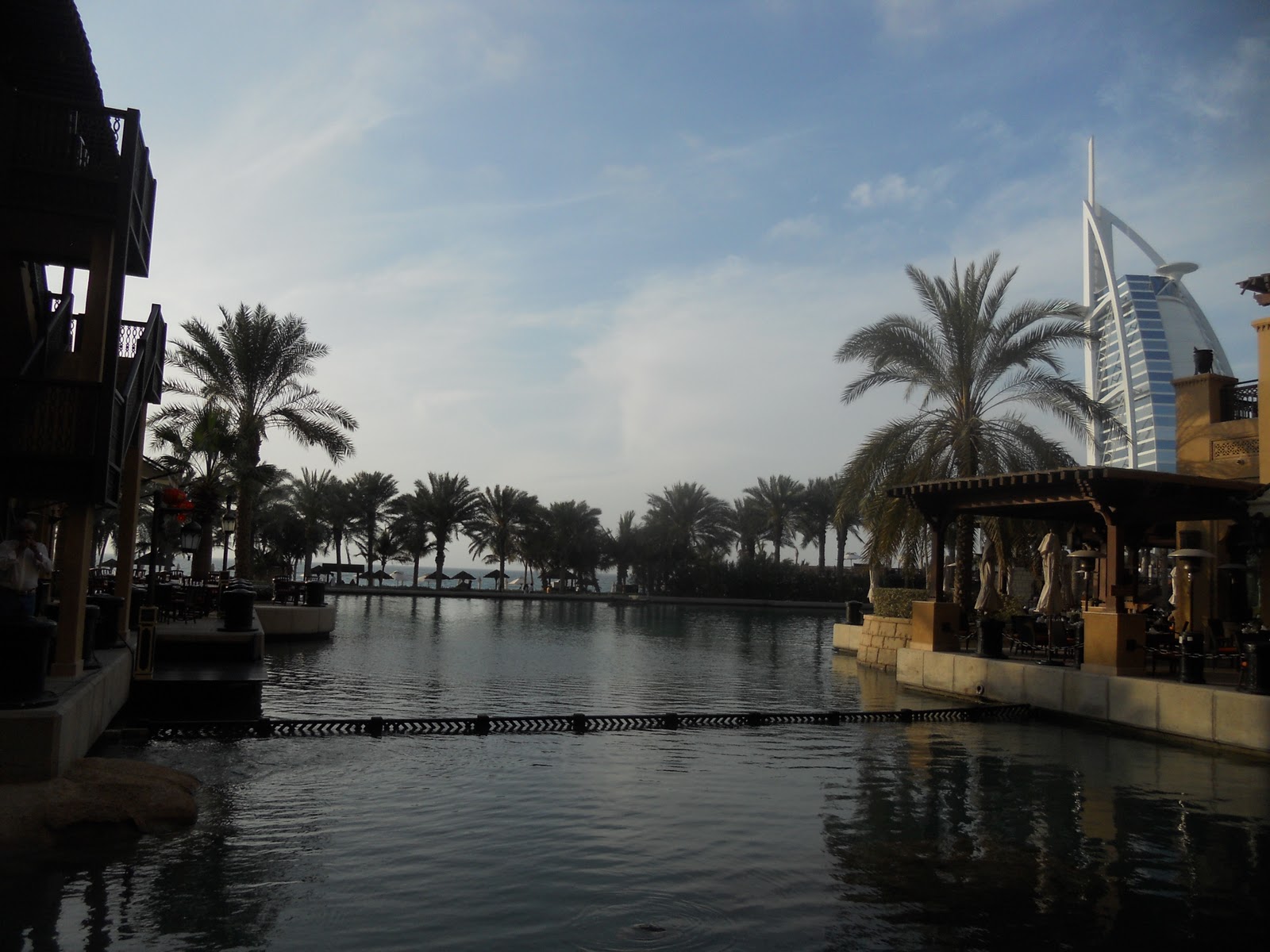
The view from one of the luxury resorts in Jumeirah.

                                       
                                                  Art Dubai.
To avoid breaking the bank, Mike and I generally hung out away from the costs of the expensive districts. Instead, we spent our days in Bur Dubai, a neighborhood near the river with a lot of quaint Middle Eastern flavor. In true Dubai fashion, we gorged ourselves on enormous Indian meals and smoked hookah constantly. It was quite relaxing and rejuvenating, particularly after the chaos and commotion of South/Southeast Asia. We meandered through the spice, gold, and textile souqs by the river. We admired the mosques and the traditional garb of the locals. To be quite honest, though, we just lazed around most days, wandering around and planning little outside of our next meal. 
Shop in the Spice Souq

Typical day in Bur Dubai.

Mosque.
That's about all I have on Dubai. It's a really cool city, and I'm glad I got to see it. There were no especially notable things that happened to us. Probably fortunately, we had a comfortable, safe, clean, gluttonous week.

However, it was pretty interesting to be stationed on the Arabian Peninsula at this particular moment in world history. As everyone knows, the region has been undergoing some changes that are incredible, promising, uncertain, and--if nothing else--notable. From Libya to Egypt to Syria to Bahrain to Tunisia to Yemen, citizens of Arab nations have chosen this moment to stage rebellions and so-called "Facebook Revolutions" against their governing regimes. Additionally, the West's decision to engage militarily against Gaddafi in Libya adds further spice to the geopolitical scene.
Obviously, the United Arab Emirates does not appear on that list of endangered countries. Nevertheless, it's an interesting place from which to watch it all unfold. I don't yet know how I feel about the United States' military commitment, though I must say I strongly approve of the diplomacy and delicacy with which the Obama administration dealt with France, Britain, and the nations of the Middle East. I hate to wave my flag behind any American military action that doesn't directly involve U.S. security, but, assuming the BBC and other news media aren't spinning the reality of Gaddafi's brutality too badly, I must say that I am inclined to support the international community in its mission to support the organic rebellions taking place. However, that may be putting undeserved faith in the media. Pining after such things as natural resources (oil) to shipping routes (colonial history) to strategic military posts (World War I), the West has a long history of dubious and cynical motivations for involving themselves in the affairs of the Middle East. Unfortunately, I'm slightly skeptical about the newest military operations, but I am simultaneously optimistic. Indeed, this new round of protests and rebellions seems genuine and locally grown. I hope that the Western nations are sincere in their commitment to simply preserve the safety of civilians. I hope that the dictators of the region fall, and I hope that the local people henceforth have control over their own futures. More than anything, I hope that this military action will not merely add yet another example of sinister self-interest on the part of Western nations. Perhaps I am being led astray by reporters and politicians—it certainly wouldn’t be the first time. Truthfully, though tentatively, I believe that we are doing the right thing, and I believe that the motives of the West are true. However, only time will tell, and I sincerely hope that history does not prove me wrong. It would be a damned shame to engage in more senseless war.
"Be well, do good work, and keep in touch."

.

Monday, March 14, 2011

"K-k-k-k-k-k-Kathmandu! I think it's really where I'm going to..." or "Back in your old neighborhood..."

My time in Southeast Asia has come to an end. Originally, I had ambitious plans to visit many countries in the region. By the time I departed on March 9, though, I had only made it to two of them (Thailand and Myanmar). At first, I was bummed about this. After all, who knows when I will have another opportunity to visit Laos or Malaysia or Indonesia? However, that's exactly why I refused to create an itinerary for this trip. I wanted the freedom to be able to stay in certain cities longer and skip over others. Indeed, I wish I had visited Laos--or Indonesia or Malaysia for that matter--but I do not regret a single travel decision I have made thus far. I got a much deeper feel for Thailand than I did when I visited Bangkok during Semester at Sea. Furthermore, I managed to get into Burma, which overwhelmed me with hospitality and intrigue. I would love to spend months and months in any and every country across the globe, but that's just not a possibility. So, I need to count my lucky stars that I'm able to embark on a journey like this at all.

Even if I did leave Southeast Asia without a couple of desired stamps in my passport, nothing could make me happier than returning to one of my favorite cities on Earth: Kathmandu, Nepal. I first visited here in the summer of 2008, and I became hooked immediately. As an anthropology major, I decided that I would conduct my field research here. It's difficult to describe exactly why I love this city so much. It's secluded, nestled in a valley of the Himalayas. It's cultural blends offer a great mix of local Nepali, Tibetan, Chinese, and Indian lifestyles, cuisines, dress, and languages. I'm not one for religion, but one would be hard-pressed to find a more spiritual place than Nepal (see below). The Hindu majority and the Tibetan Buddhist minority really make the city's spirituality feel alive. Walking through the smoggy streets, you're never too far from a music shop blaring a recording of monks singing "Om Mani Padme Hum," a mantra of compassion that roughly translates to "Hail to the Jewel of the Lotus Flower."

Mike and I arrived in Kathmandu on the 9th. We booked a room at the Red Planet Guesthouse in Thamel, the tourist district of the city. That's where we have been spending most of our time so far. It's a crazy neighborhood, a labyrinth of streets flooded with hawkers, internet cafes, ethnic restaurants, book stores, and travel agencies. Although Kathmandu is hardly on the well worn tourist track, all the travelers here basically pass through Thamel, and they are all going in a million different directions. Some are on their way to the jungles. Others are going trekking through the mountains. A few are gearing up to climb the iconic mountains like Everest or Annapurna. Others are simply waiting for their visas to come through so that they can move on into politically difficult places like Tibet or Pakistan. Many are on side-trips from northern India. Whatever brings all of these people to Thamel, Kathmandu, the neighborhood is a great place to meet fellow travelers.

Our second night here, Mike and I met a group of volunteers who host a trivia night every Thursday at a small pub in Thamel. We decided to give it a try (we got 2nd place). Even though we didn't win, we met a truly great group of people. The gathering offered everything I enjoy about meeting random travelers in random bars in random cities. There were about 8 Irish, 1 Scottish, 1 French, 2 Canadians, and several Nepalis--and, of course, Mike and I representing America. We drank and ate food and answered trivia questions. We jested about each other's nationalities. We swapped travel stories. It was really a great night. Again, that's one of the greatest things about traveling. I cannot say for sure that I will ever see any of them again--although we will probably be heading back for more trivia. Regardless, though, we had a great, fun night together. It's a strange type of bond you have with other foreigners in places like Kathmandu. Everybody has a story, and it's usually a pretty cool story. You meet and drink with people knowing full well that the friendship will almost certainly not last, yet the bond feels close and joyous nonetheless.
Night in the narrow, crowded streets of Thamel, Kathmandu.
After a couple of days kicking around Thamel, Mike and I decided to visit some of the monuments and sights around the city. I had seen these on my first trip here, and they were no less breathtaking the second time around. First, we visited Kathmandu's Durbar Square, a complex of palaces and temples. It's right next to Freak Street, where the hippies of the 60s/70s would end their overland journeys along the Silk Road. We also visited Bodhnath Stupa, one of the largest Buddhist structures in the world. It's enormous and whitewashed, and Tibetan monks and refugees circumnavigate the structure, turning prayer wheels and mumbling mantras to themselves. It's quite a sight to see. Nepal has a huge number of Tibetan refugees, so there are pockets of Kathmandu that are full of devout Buddhists and great Tibetan restaurants. Finally, we spent the evening hours at Swayambhunath, or the "Monkey Temple." It's a big monastery and temple that sits atop a hill that overlooks the whole Kathmandu Valley. If you couldn't tell from the alternate name, there are also a lot of wild macaque monkeys around. Again, the temple is pretty amazing. There are hundreds of multicolored Tibetan prayer flags strung above the visitor's heads, the idea being that with each flap in the wind it sends up a prayer for peace and compassion. It's quite a nice thought, regardless of one's religious disposition. It feels very peaceful and quiet, especially when juxtaposed against the chaotic traffic and smog of the city. Here are some photos that I took:
Mother and child. I took this on our long-detoured walk to Durbar Square.
Durbar Square.
Hindu shrine at Durbar Square.
Bodhnath Stupa
Me in front of the stupa.
Multicolored prayer flags strung across the huge stupa.
Prayer flags at the monastery at Swayambhunath. Tons of them.
The stupa at Swayambunath. It's much smaller than Bodhnath, but the same design.
Today, Mike and I finally made it out to see Bina, my friend and the founder of the school I volunteered at when I visited Kathmandu in 2008. On sort of a whim, Mike and I found cheap tickets to Dubai, United Arab Emirates. So, we decided to jump on them. We will be there for the next week, so we wanted to leave our big bags with Bina, where I knew they would be safe. Friendly as ever, Bina showed us the vast improvements she has made to her school. She told me that they have hired more teachers and have received generous support from several volunteers and donors. The school looks wonderful, and I instantly remembered why I love Kathmandu so much. Bina is friendly and generous. In exchange for playing with the kids and tutoring them (not a terribly challenging job), she gives us a free place to stay and meals. There are already two volunteers staying there, but she assured us that her door was always open to us. Bina is just one more example of true kindness and hospitality. I also caught up with her son, who, oddly enough, will be attending Wabash College in Crawfordsville, Indiana starting in August. He only needs to procure a student visa from the U.S. Embassy, so Mike and I will help him do that in any way that we can. He's a cool guy, and I look forward to hanging out with him a bit more when we return from Dubai and start staying with Bina (instead of in the far-more-hectic Thamel).

I feel comfortable in Kathmandu. It's a great place, and I can't exactly say why. The streets are dusty, infrastructure is shoddy (at best), the air is smoggy, and you can't drink the water. In spite of all of that, though, there is a certain magic and electricity in the air. Something about Nepal gives you the feeling like you're at the end of the world, in one of the most remote regions imaginable. There are many travelers, but it doesn't feel annoying. It feels like everyone "gets it" in Nepal. Kathmandu is a hidden gem of a city. It's not as chaotic as India, and not as touristy as Bangkok. In the folds of the foothills of the Himalayas, it feels like you are disconnected from everything else on Earth. It's a land of brilliant colors and wonderful souvenirs. It has been touched by globalization and modernization, but it adopts these things in a distinctly Nepalese way. It's hard to say why I feel so attracted to Kathmandu. I thought it might be a peculiarity about me. So far, though, Mike loves it, too. Perhaps it's not something in my character that draws me back to Kathmandu. Perhaps it really is something in the fabric of the city.

"Be well, do good work, and keep in touch."


.

Sunday, March 6, 2011

"All the people that come and go stop and say hello" or "The revolution will not be televised."

Well, I did it. I believe that I’ve found the friendliest people on the planet. Perhaps surprisingly, they live in… Burma. Or “Myanmar,” depending on the person you ask. I’ll deal with the name confusion and political situation later (that’s what “see below” means henceforth). For now, here’s a summary of what I’ve been doing for the past couple of weeks.

On the 19th, we (Mike, Nora, Grant, Josh, and I) all arrived in Rangoon/Yangon. The city used to be the capital of Burma/Myanmar, but the government changed it relatively recently for absurd reasons dealing with some bad astrological omen. Anyway, the city is amazing. It’s difficult to describe accurately, but imagine some war-torn, 19th-century European city that has since been abandoned. That sounds negative, I know, but I mean it in the most complimentary way possible. Rangoon/Yangon is like a forgotten gem. There aren’t many tourists there at all, so you feel like you’re getting a certain authenticity that much of Thailand and other destinations lack.

A friend of Nora’s set us up with a friend of hers who lives here, and that’s where the unimaginable friendliness and hospitality began. He met us at the airport, paid for our two taxis to the central part of the city, took us out to tea (which he also paid for), and set us up with a fantastic guest house all within an hour of meeting him for the first time. For the next few days, he took us around to different parts of the city. If he was busy (having his own life), he gave us detailed suggestions. In the few days we spent in Rangoon/Yangon, we visited (among other impressive temples) the Shwedagon Paya, an enormous, golden temple that one can see from all over the city; took the $1 Circle Train around the whole city, which allowed us to see some of the outlying areas, which included an accidental stop at the eerily repressed Insein (see below); went to Inya Lake, a beautiful landscape from where you can see Aung San Suu Kyi’s home (see below);  and walked through the night markets in the Chinese and Indian Quarters of town. Here are some photos from the city:
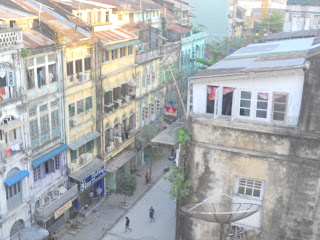
The view from the roof of our guesthouse.
Getting a beer.
Shwedagon Pagoda in Rangoon/Yangon.
A Buddhist woman at one of the pagoda's that supposedly houses some of the Buddha's hairs.
Me being awkward in a holy site.
Our friend’s generosity did not end there—far from it, in fact. Because of the government’s repression, distrust of outsiders, and general political paranoia, there is an unbelievable amount of red tape to cut and bureaucratic hoops to jump through before you can do any inter-city travel in Burma. Some roads are closed off to foreigners, and the rules often change regarding where you can go. Even Lonely Planet, which always offers inexpensive ways to get around, said that traveling over land in Burma/Myanmar is often more trouble than it’s worth. Luckily, our friend, who happens to be a trekking guide, organized everything for us. He dealt with the arrangements to get bus tickets, and (more importantly) he secured the permit required to leave the country overland into Thailand, which would have taken much longer if we had done it ourselves. He arranged for a boat to take us around Inle Lake when we arrived there a week later. He organized our flight to the border town from where we could leave (because you cannot get there by bus as a tourist). It’s hard to explain how much work all of this actually was. In short, we would have been totally lost without him, and we probably would have ended up breaking down and buying a plane ticket back to Bangkok in order to leave, which would have been more expensive and far out of the way. What’s more, he did us all of these favors with a smile. We thanked him profusely, yet he never acted like it was a big deal. In truth, though, I have never experienced such hospitality from ANYONE, let alone someone I have only known for a couple of days. He kept saying things like, “You guys are family now… my brothers and sisters.” And it didn’t feel like empty rhetoric. It felt honest and sincere. We kept in contact with him throughout our travels in the country, and he continued to help us out along the way. It was all quite incredible and, at the risk of sounding sentimental and overblown, heartwarming.

We left Rangoon/Yangon a few days later and headed for Pagan/Bagan. Grant and Josh went back to Bangkok (they were only in Burma/Myanmar on a short visa run), so it was down to just Mike, Nora, and me. Pagan/Bagan is an ancient region littered with old temples (about 4,400 in total). I’ve never seen anything quite like it. It can hold its weight with any of the world-famous sights (Angkor Wat, the Coliseum, Chitzen Itza, etc.), but it lacks the hoards of tourists that crowd and clutter those places. That will all change as soon as the political situation shifts here, and I have no doubt that Pagan/Bagan will then take its rightful place as one of the coolest sightseeing destinations to visit in the world. Lonely Planet describes it this way: “Gather all of Europe’s medieval cathedrals onto Manhattan island and throw in a whole lot more for good measure, and you’ll start to get a sense of the ambition of the temple-filled plains of Bagan.” That’s about right. We spent our first day on rented bicycles cycling around the dusty streets visiting the noteworthy temples of Old Bagan, the heart of the region. The next day, we went to an outlying area, where we saw an Indiana Jones-esque cave temple and a monastery temple near the banks of the lovely Irrawaddy/Ayeyarwady River. On our final day in the town, we went to Mount Popa, a mind-blowing white temple that sits atop a steep, thin mountain. Again, words are failing me, so here are some of the photos I took:
Old Bagan.
Same picture, but with me in it.
Monk hanging out in front of his monastery's ancient temple.
Mount Popa.
Suset in Old Bagan.
After the worst bus ride of my life, we made it to Kalaw, a small town in the hills. It happens to be the hometown of our friend from Rangoon/Yangon, and it’s where most tourists go to start trekking toward Inle Lake. We booked a three-day trek through out guesthouse. Our guide, K.T., seemed a bit cold at first because he had just returned from another trek. However, as soon as we got on the road, he warmed up a great deal, and it ended up being a wonderful experience. For the next three days, we hiked up and down through the hills of Shan State, stopping along the way for tea and meals. K.T. happened to be an amazing cook, and (in true Burmese character) offered us all more than enough food. The first night, we slept in the home of a family from the hills. We ate by candlelight because they have no electricity, and K.T. told us the gripping story of his upbringing and life in Kalaw. The second night, we stayed at a hilltop monastery, which was amazingly peaceful. It is a common stop for trekkers, so we had good conversations with several other travelers. We slept in the main hall of the monastery, so we were all awoken promptly at 5 A.M. when the novice monks (the youngsters) began their morning chants. It’s customary to make a small donation when you leave the monastery (~$1 or less). This we did, and in return we recieved a blessing from the head monk. I know that he blesses plenty of people every week, and all of you know that I do not give much credence to blessings, deities, or other things spiritual. However, the gesture was still touching, and I will continue to wear the thread that he tied around my wrist (for protection) as a reminder of the experience.
Shan State, as seen during our trek from Kalaw.
A typical meal prepared by KT, our guide. Eaten at a family's home in the hills.
Novice monks sweeping the grounds of the monastery.
A very tired me after our trek with our porter (left) and KT (right).
Finally, we made it to Inle Lake, and I’ve never been so sore in all my life. The first day, we simply passed out in our guesthouse, which is run by an extremely hospitable family (again... very friendly people). On the second day, Mike was sick, so Nora and I hired a boat to take us all around the lake. If you have any vision in mind of Burma/Myanmar, there’s a decent chance you’re thinking of Inle Lake. It’s a glassy body of water, flanked on all sides by mountains. In the morning, a mist covers the whole thing as the fisherman go out in their Burmese canoes to use their expertise. We visited many shops, and we saw a whole village that is built on bamboo stilts in the middle of one of the shallow waterways. It was really amazing. Here are some photos:
Typical fisherman on Inle Lake.
Another.
Floating Village.
 
So, finally, my musings on the political situation here: As I’ve said, Burma/Myanmar is one of the coolest places that I have ever visited. The people are friendly, the landscape is breathtaking, and the sights are world-class. To most people, it would appear pretty paradisiacal. However, there is an unmistakable air of repression, tyranny, and injustice that hangs around the whole country. If you don’t know anything about the situation here, spend a couple of minutes on Google reading about it. Basically, the country is run by a minority military junta that does not take kindly to dissent or democracy (to say the least). Aung San Suu Kyi, the woman whose house is on Inya Lake in Rangoon/Yangon, was under house arrest there for years and years because of her pivotal role in the pro-democracy movement. She only recently finished her sentence. If the government ever held an honest election, she would win in a landslide. Meanwhile, the many ethnic groups who reside in Burma/Myanmar have also suffered at the hands of the military junta, and unspeakable violence is not exactly uncommon there, particularly among political dissidents. That’s also the reason there are two names for every place in Burma/Myanmar. In this entry, the former names (i.e. Burma, Rangoon, etc.) are the original names for the given place, while the latter (i.e. Myanmar, Yangon, etc.) are the politically motivated reassignments implemented by the government. The nation has a terrible human rights record as well, and there are tough economic sanctions placed on Burma/Myanmar by the rest of world, although they are not always followed by such crucial geopolitical players as India and China. In this way, the government sustains itself and manages to evade the eventual revolution and overthrow. Only very recently were tourists encouraged to go there, under the condition that they avoid spending money at government-owned institutions whenever possible. All of this together is why there is not more tourism there, which, in a very twisted sort of way, is what made the place so enchanting during our stay.

For the most part, the military government does a good job of stifling free speech and general liberty. Nobody talks openly about the abuses of the government, but it’s always a giant elephant behind the curtains. However, the underground democracy movement and the reality of the current government do exist, and both manifested themselves to me a few times during our stay. When our friend picked us up at the airport, we were talking in the taxi. Nora asked him how he had met her friend (the friend who had hooked us up with him). They had met through pro-democracy work. Without batting an eye or losing his friendly smile, he simply said, “We can talk about that back at the hotel, but Yangon is…” and faded back into tour guide mode. The only other person in the taxi was the driver, but you can never be too careful because you never know who is in cahoots with the terrible government. The second experience occurred on the Circle Train around Rangoon/Yangon. We got to Insein, the site of the government’s torturous prison, which does not appear on maps. If you even take photos of it, you are facing serious arrest. The train was relatively lively up until we passed the prison, at which point the mood become markedly more sinister and somber. Nobody really spoke. It was all quite eerie. A few minutes after we had passed the actual prison, the man sitting next to me struck up a friendly conversation, which is not uncommon. It went something like this:
“What is your name?”
“Ben.”
“You are graduate?”
“Yes, we all just graduated, so now we travel.”
“Where are you from?”
“United States”
“America?”
“Yes.”
[At this point, he leaned in very close to my ear and started to whisper.]
“Use your liberty to promote ours.”
To this, I could only nod like a fool. Nora told me later that the statement is a quote from the aforementioned Aung San Suu Kyi. It was awfully affecting, particularly considering the types of risks associated with speaking like that to strangers in public places. These types of experiences really brought home the degree to which political repression and a lack of liberty can affect a nation. It really does hang over everything like a huge dark cloud. It’s largely unspoken, so silences, like the one on the Circle Train, seem long, brutal, and spooky.

As with all dark clouds, though, silver linings do exist. First and foremost, it’s promising that the pro-democracy movement exists. By all means, it continues to promote justice and freedom in spite of the relentless attempts by the government to stifle them.

The second silver lining was closer to my personal experiences in Burma, and that one deals with the general disposition of the people there. As I said before, they truly are the friendliest people I have ever come across. Not a day went by that a stranger on the street wouldn’t strike up a conversation with us. Usually, it happened at least a few times daily. Sometimes, they only wanted to know where we were from. Other times, they wanted to practice their spoken English. In one instance, we had a guy hang out with us for the remainder of the day in Rangoon/Yangon. The people in that country, in spite of all the efforts on the part of their military government to the contrary, have not lost their amicable spirits. They took a genuine interest in us. Too often while traveling, you feel that locals strike up conversations because of some thinly veiled ulterior motive (“Come to my shop,” “I can show you the temple for…,” etc.). That simply did not really occur in Burma/Myanmar. The interest was sincere and mutual. They seemed to enjoy talking to foreigners, and the casual conversations were a breath of fresh air for both parties involved. It’s inspiring to see that in a country so ravaged by decades of political violence and tyranny. The good-natured people have not lost their senses of hospitality and generosity, nor their incredible sense of humor. Without getting too preachy, I’m pretty sure that there is an important lesson in there somewhere. Governments, violence, and fear can do a lot of things, but they cannot kill the hearts and spirits of human beings unless the victims of such forces allow them to do so. For proof of this, I highly recommend a trip to Burma.

“Be well, do good work, and keep in touch.”