Monday, March 21, 2011

"Arabian Nights" or "Lifestyles of the rich and the famous" or "War! (Huh, yeah) What is it good for?"

Our week-long, random, relaxing trip to Dubai has come to an end, and I'm not exactly sure what to write in this blog entry. Dubai is quite an amazing city. It's young, incredibly wealthy, over-the-top, yet deeply grounded in the Arabian Peninsula's rich Islamic tradition. I had heard tidbits about Dubai before arriving: a perfect 21st-century city, a city hell-bent on breaking every urban record imaginable, "the gem of the Middle East," etc.

I don't have a lot to say about my experiences in Dubai, but I can say that everything that I expected from the city is basically true. The skyline alone is worth the trip. In addition to the world's tallest building--which towers over the whole city in an unimaginable way--the city boasts a hodgepodge of interesting and awe-inspiring architecture. One day, Mike and I went for a long walk through downtown, gawking at all of the buildings. Perhaps it's just because I've been out of big cities (except Bangkok) for a while, but I don't think so. Dubai has built itself up into an extremely impressive city.

Dubai Skyline.
The World's Tallest building.
One of Dubai's many upscale malls.

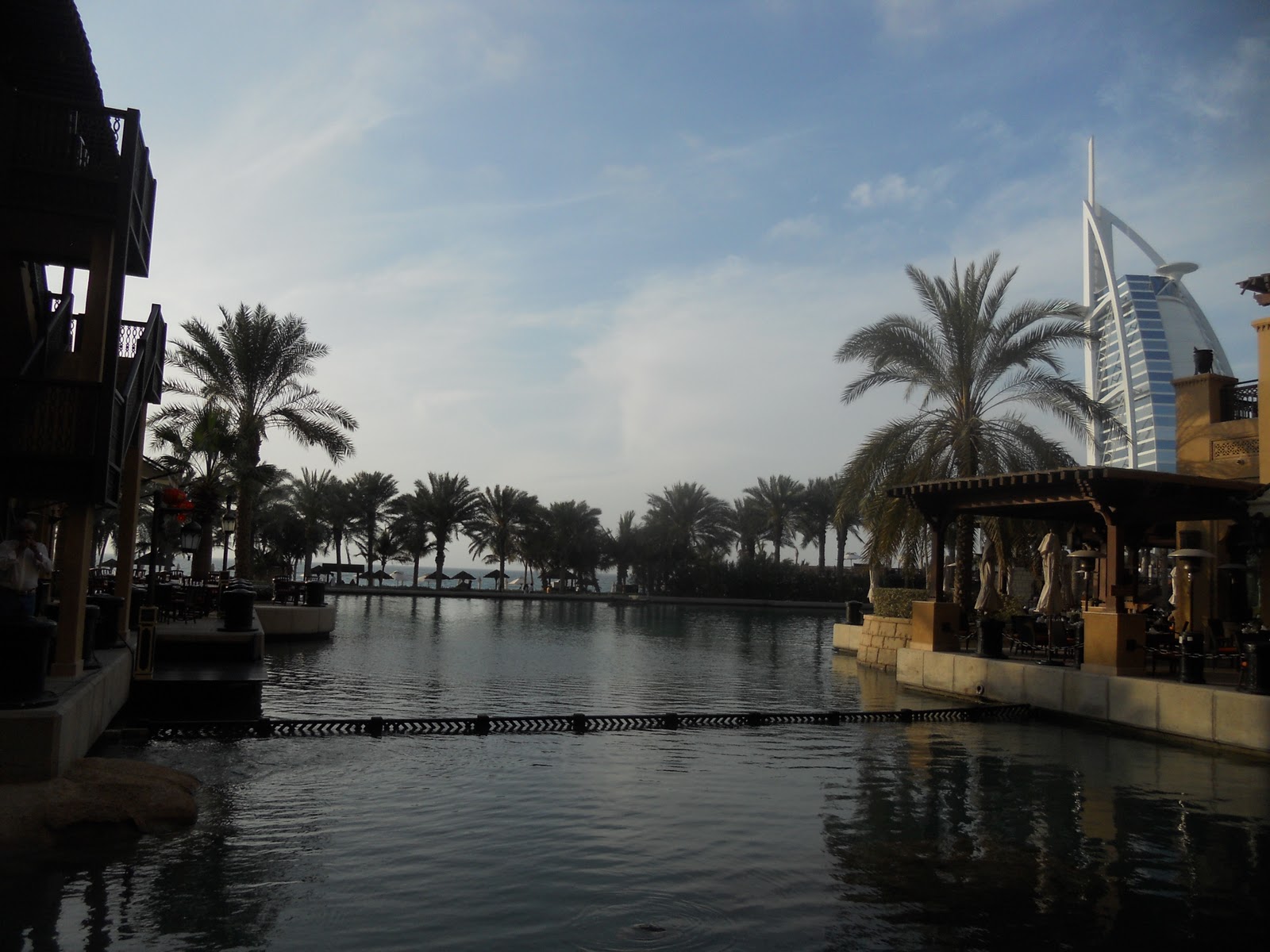
In Jumeirah, the beach resort area of the city, there are some amazing hotels. Our trip happened to coincide with Art Dubai, the city's big art festival. It was held at an enormous Vegas-style hotel resort, which Lonely Planet described as "a city within a city." Within moments of entering the art exhibits, Mike and I felt entirely out of place. It was perhaps the most bourgeois affair I have ever attended--suited socialites drinking cocktails, high-brow artists showcasing their works, the whole nine yards. Even so, the exhibits were really awesome, and we were lucky to stumble upon it.
The view from one of the luxury resorts in Jumeirah.

                                       
                                                  Art Dubai.
To avoid breaking the bank, Mike and I generally hung out away from the costs of the expensive districts. Instead, we spent our days in Bur Dubai, a neighborhood near the river with a lot of quaint Middle Eastern flavor. In true Dubai fashion, we gorged ourselves on enormous Indian meals and smoked hookah constantly. It was quite relaxing and rejuvenating, particularly after the chaos and commotion of South/Southeast Asia. We meandered through the spice, gold, and textile souqs by the river. We admired the mosques and the traditional garb of the locals. To be quite honest, though, we just lazed around most days, wandering around and planning little outside of our next meal. 
Shop in the Spice Souq

Typical day in Bur Dubai.

Mosque.
That's about all I have on Dubai. It's a really cool city, and I'm glad I got to see it. There were no especially notable things that happened to us. Probably fortunately, we had a comfortable, safe, clean, gluttonous week.

However, it was pretty interesting to be stationed on the Arabian Peninsula at this particular moment in world history. As everyone knows, the region has been undergoing some changes that are incredible, promising, uncertain, and--if nothing else--notable. From Libya to Egypt to Syria to Bahrain to Tunisia to Yemen, citizens of Arab nations have chosen this moment to stage rebellions and so-called "Facebook Revolutions" against their governing regimes. Additionally, the West's decision to engage militarily against Gaddafi in Libya adds further spice to the geopolitical scene.
Obviously, the United Arab Emirates does not appear on that list of endangered countries. Nevertheless, it's an interesting place from which to watch it all unfold. I don't yet know how I feel about the United States' military commitment, though I must say I strongly approve of the diplomacy and delicacy with which the Obama administration dealt with France, Britain, and the nations of the Middle East. I hate to wave my flag behind any American military action that doesn't directly involve U.S. security, but, assuming the BBC and other news media aren't spinning the reality of Gaddafi's brutality too badly, I must say that I am inclined to support the international community in its mission to support the organic rebellions taking place. However, that may be putting undeserved faith in the media. Pining after such things as natural resources (oil) to shipping routes (colonial history) to strategic military posts (World War I), the West has a long history of dubious and cynical motivations for involving themselves in the affairs of the Middle East. Unfortunately, I'm slightly skeptical about the newest military operations, but I am simultaneously optimistic. Indeed, this new round of protests and rebellions seems genuine and locally grown. I hope that the Western nations are sincere in their commitment to simply preserve the safety of civilians. I hope that the dictators of the region fall, and I hope that the local people henceforth have control over their own futures. More than anything, I hope that this military action will not merely add yet another example of sinister self-interest on the part of Western nations. Perhaps I am being led astray by reporters and politicians—it certainly wouldn’t be the first time. Truthfully, though tentatively, I believe that we are doing the right thing, and I believe that the motives of the West are true. However, only time will tell, and I sincerely hope that history does not prove me wrong. It would be a damned shame to engage in more senseless war.
"Be well, do good work, and keep in touch."

.

Monday, March 14, 2011

"K-k-k-k-k-k-Kathmandu! I think it's really where I'm going to..." or "Back in your old neighborhood..."

My time in Southeast Asia has come to an end. Originally, I had ambitious plans to visit many countries in the region. By the time I departed on March 9, though, I had only made it to two of them (Thailand and Myanmar). At first, I was bummed about this. After all, who knows when I will have another opportunity to visit Laos or Malaysia or Indonesia? However, that's exactly why I refused to create an itinerary for this trip. I wanted the freedom to be able to stay in certain cities longer and skip over others. Indeed, I wish I had visited Laos--or Indonesia or Malaysia for that matter--but I do not regret a single travel decision I have made thus far. I got a much deeper feel for Thailand than I did when I visited Bangkok during Semester at Sea. Furthermore, I managed to get into Burma, which overwhelmed me with hospitality and intrigue. I would love to spend months and months in any and every country across the globe, but that's just not a possibility. So, I need to count my lucky stars that I'm able to embark on a journey like this at all.

Even if I did leave Southeast Asia without a couple of desired stamps in my passport, nothing could make me happier than returning to one of my favorite cities on Earth: Kathmandu, Nepal. I first visited here in the summer of 2008, and I became hooked immediately. As an anthropology major, I decided that I would conduct my field research here. It's difficult to describe exactly why I love this city so much. It's secluded, nestled in a valley of the Himalayas. It's cultural blends offer a great mix of local Nepali, Tibetan, Chinese, and Indian lifestyles, cuisines, dress, and languages. I'm not one for religion, but one would be hard-pressed to find a more spiritual place than Nepal (see below). The Hindu majority and the Tibetan Buddhist minority really make the city's spirituality feel alive. Walking through the smoggy streets, you're never too far from a music shop blaring a recording of monks singing "Om Mani Padme Hum," a mantra of compassion that roughly translates to "Hail to the Jewel of the Lotus Flower."

Mike and I arrived in Kathmandu on the 9th. We booked a room at the Red Planet Guesthouse in Thamel, the tourist district of the city. That's where we have been spending most of our time so far. It's a crazy neighborhood, a labyrinth of streets flooded with hawkers, internet cafes, ethnic restaurants, book stores, and travel agencies. Although Kathmandu is hardly on the well worn tourist track, all the travelers here basically pass through Thamel, and they are all going in a million different directions. Some are on their way to the jungles. Others are going trekking through the mountains. A few are gearing up to climb the iconic mountains like Everest or Annapurna. Others are simply waiting for their visas to come through so that they can move on into politically difficult places like Tibet or Pakistan. Many are on side-trips from northern India. Whatever brings all of these people to Thamel, Kathmandu, the neighborhood is a great place to meet fellow travelers.

Our second night here, Mike and I met a group of volunteers who host a trivia night every Thursday at a small pub in Thamel. We decided to give it a try (we got 2nd place). Even though we didn't win, we met a truly great group of people. The gathering offered everything I enjoy about meeting random travelers in random bars in random cities. There were about 8 Irish, 1 Scottish, 1 French, 2 Canadians, and several Nepalis--and, of course, Mike and I representing America. We drank and ate food and answered trivia questions. We jested about each other's nationalities. We swapped travel stories. It was really a great night. Again, that's one of the greatest things about traveling. I cannot say for sure that I will ever see any of them again--although we will probably be heading back for more trivia. Regardless, though, we had a great, fun night together. It's a strange type of bond you have with other foreigners in places like Kathmandu. Everybody has a story, and it's usually a pretty cool story. You meet and drink with people knowing full well that the friendship will almost certainly not last, yet the bond feels close and joyous nonetheless.
Night in the narrow, crowded streets of Thamel, Kathmandu.
After a couple of days kicking around Thamel, Mike and I decided to visit some of the monuments and sights around the city. I had seen these on my first trip here, and they were no less breathtaking the second time around. First, we visited Kathmandu's Durbar Square, a complex of palaces and temples. It's right next to Freak Street, where the hippies of the 60s/70s would end their overland journeys along the Silk Road. We also visited Bodhnath Stupa, one of the largest Buddhist structures in the world. It's enormous and whitewashed, and Tibetan monks and refugees circumnavigate the structure, turning prayer wheels and mumbling mantras to themselves. It's quite a sight to see. Nepal has a huge number of Tibetan refugees, so there are pockets of Kathmandu that are full of devout Buddhists and great Tibetan restaurants. Finally, we spent the evening hours at Swayambhunath, or the "Monkey Temple." It's a big monastery and temple that sits atop a hill that overlooks the whole Kathmandu Valley. If you couldn't tell from the alternate name, there are also a lot of wild macaque monkeys around. Again, the temple is pretty amazing. There are hundreds of multicolored Tibetan prayer flags strung above the visitor's heads, the idea being that with each flap in the wind it sends up a prayer for peace and compassion. It's quite a nice thought, regardless of one's religious disposition. It feels very peaceful and quiet, especially when juxtaposed against the chaotic traffic and smog of the city. Here are some photos that I took:
Mother and child. I took this on our long-detoured walk to Durbar Square.
Durbar Square.
Hindu shrine at Durbar Square.
Bodhnath Stupa
Me in front of the stupa.
Multicolored prayer flags strung across the huge stupa.
Prayer flags at the monastery at Swayambhunath. Tons of them.
The stupa at Swayambunath. It's much smaller than Bodhnath, but the same design.
Today, Mike and I finally made it out to see Bina, my friend and the founder of the school I volunteered at when I visited Kathmandu in 2008. On sort of a whim, Mike and I found cheap tickets to Dubai, United Arab Emirates. So, we decided to jump on them. We will be there for the next week, so we wanted to leave our big bags with Bina, where I knew they would be safe. Friendly as ever, Bina showed us the vast improvements she has made to her school. She told me that they have hired more teachers and have received generous support from several volunteers and donors. The school looks wonderful, and I instantly remembered why I love Kathmandu so much. Bina is friendly and generous. In exchange for playing with the kids and tutoring them (not a terribly challenging job), she gives us a free place to stay and meals. There are already two volunteers staying there, but she assured us that her door was always open to us. Bina is just one more example of true kindness and hospitality. I also caught up with her son, who, oddly enough, will be attending Wabash College in Crawfordsville, Indiana starting in August. He only needs to procure a student visa from the U.S. Embassy, so Mike and I will help him do that in any way that we can. He's a cool guy, and I look forward to hanging out with him a bit more when we return from Dubai and start staying with Bina (instead of in the far-more-hectic Thamel).

I feel comfortable in Kathmandu. It's a great place, and I can't exactly say why. The streets are dusty, infrastructure is shoddy (at best), the air is smoggy, and you can't drink the water. In spite of all of that, though, there is a certain magic and electricity in the air. Something about Nepal gives you the feeling like you're at the end of the world, in one of the most remote regions imaginable. There are many travelers, but it doesn't feel annoying. It feels like everyone "gets it" in Nepal. Kathmandu is a hidden gem of a city. It's not as chaotic as India, and not as touristy as Bangkok. In the folds of the foothills of the Himalayas, it feels like you are disconnected from everything else on Earth. It's a land of brilliant colors and wonderful souvenirs. It has been touched by globalization and modernization, but it adopts these things in a distinctly Nepalese way. It's hard to say why I feel so attracted to Kathmandu. I thought it might be a peculiarity about me. So far, though, Mike loves it, too. Perhaps it's not something in my character that draws me back to Kathmandu. Perhaps it really is something in the fabric of the city.

"Be well, do good work, and keep in touch."


.

Sunday, March 6, 2011

"All the people that come and go stop and say hello" or "The revolution will not be televised."

Well, I did it. I believe that I’ve found the friendliest people on the planet. Perhaps surprisingly, they live in… Burma. Or “Myanmar,” depending on the person you ask. I’ll deal with the name confusion and political situation later (that’s what “see below” means henceforth). For now, here’s a summary of what I’ve been doing for the past couple of weeks.

On the 19th, we (Mike, Nora, Grant, Josh, and I) all arrived in Rangoon/Yangon. The city used to be the capital of Burma/Myanmar, but the government changed it relatively recently for absurd reasons dealing with some bad astrological omen. Anyway, the city is amazing. It’s difficult to describe accurately, but imagine some war-torn, 19th-century European city that has since been abandoned. That sounds negative, I know, but I mean it in the most complimentary way possible. Rangoon/Yangon is like a forgotten gem. There aren’t many tourists there at all, so you feel like you’re getting a certain authenticity that much of Thailand and other destinations lack.

A friend of Nora’s set us up with a friend of hers who lives here, and that’s where the unimaginable friendliness and hospitality began. He met us at the airport, paid for our two taxis to the central part of the city, took us out to tea (which he also paid for), and set us up with a fantastic guest house all within an hour of meeting him for the first time. For the next few days, he took us around to different parts of the city. If he was busy (having his own life), he gave us detailed suggestions. In the few days we spent in Rangoon/Yangon, we visited (among other impressive temples) the Shwedagon Paya, an enormous, golden temple that one can see from all over the city; took the $1 Circle Train around the whole city, which allowed us to see some of the outlying areas, which included an accidental stop at the eerily repressed Insein (see below); went to Inya Lake, a beautiful landscape from where you can see Aung San Suu Kyi’s home (see below);  and walked through the night markets in the Chinese and Indian Quarters of town. Here are some photos from the city:
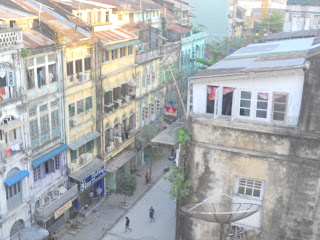
The view from the roof of our guesthouse.
Getting a beer.
Shwedagon Pagoda in Rangoon/Yangon.
A Buddhist woman at one of the pagoda's that supposedly houses some of the Buddha's hairs.
Me being awkward in a holy site.
Our friend’s generosity did not end there—far from it, in fact. Because of the government’s repression, distrust of outsiders, and general political paranoia, there is an unbelievable amount of red tape to cut and bureaucratic hoops to jump through before you can do any inter-city travel in Burma. Some roads are closed off to foreigners, and the rules often change regarding where you can go. Even Lonely Planet, which always offers inexpensive ways to get around, said that traveling over land in Burma/Myanmar is often more trouble than it’s worth. Luckily, our friend, who happens to be a trekking guide, organized everything for us. He dealt with the arrangements to get bus tickets, and (more importantly) he secured the permit required to leave the country overland into Thailand, which would have taken much longer if we had done it ourselves. He arranged for a boat to take us around Inle Lake when we arrived there a week later. He organized our flight to the border town from where we could leave (because you cannot get there by bus as a tourist). It’s hard to explain how much work all of this actually was. In short, we would have been totally lost without him, and we probably would have ended up breaking down and buying a plane ticket back to Bangkok in order to leave, which would have been more expensive and far out of the way. What’s more, he did us all of these favors with a smile. We thanked him profusely, yet he never acted like it was a big deal. In truth, though, I have never experienced such hospitality from ANYONE, let alone someone I have only known for a couple of days. He kept saying things like, “You guys are family now… my brothers and sisters.” And it didn’t feel like empty rhetoric. It felt honest and sincere. We kept in contact with him throughout our travels in the country, and he continued to help us out along the way. It was all quite incredible and, at the risk of sounding sentimental and overblown, heartwarming.

We left Rangoon/Yangon a few days later and headed for Pagan/Bagan. Grant and Josh went back to Bangkok (they were only in Burma/Myanmar on a short visa run), so it was down to just Mike, Nora, and me. Pagan/Bagan is an ancient region littered with old temples (about 4,400 in total). I’ve never seen anything quite like it. It can hold its weight with any of the world-famous sights (Angkor Wat, the Coliseum, Chitzen Itza, etc.), but it lacks the hoards of tourists that crowd and clutter those places. That will all change as soon as the political situation shifts here, and I have no doubt that Pagan/Bagan will then take its rightful place as one of the coolest sightseeing destinations to visit in the world. Lonely Planet describes it this way: “Gather all of Europe’s medieval cathedrals onto Manhattan island and throw in a whole lot more for good measure, and you’ll start to get a sense of the ambition of the temple-filled plains of Bagan.” That’s about right. We spent our first day on rented bicycles cycling around the dusty streets visiting the noteworthy temples of Old Bagan, the heart of the region. The next day, we went to an outlying area, where we saw an Indiana Jones-esque cave temple and a monastery temple near the banks of the lovely Irrawaddy/Ayeyarwady River. On our final day in the town, we went to Mount Popa, a mind-blowing white temple that sits atop a steep, thin mountain. Again, words are failing me, so here are some of the photos I took:
Old Bagan.
Same picture, but with me in it.
Monk hanging out in front of his monastery's ancient temple.
Mount Popa.
Suset in Old Bagan.
After the worst bus ride of my life, we made it to Kalaw, a small town in the hills. It happens to be the hometown of our friend from Rangoon/Yangon, and it’s where most tourists go to start trekking toward Inle Lake. We booked a three-day trek through out guesthouse. Our guide, K.T., seemed a bit cold at first because he had just returned from another trek. However, as soon as we got on the road, he warmed up a great deal, and it ended up being a wonderful experience. For the next three days, we hiked up and down through the hills of Shan State, stopping along the way for tea and meals. K.T. happened to be an amazing cook, and (in true Burmese character) offered us all more than enough food. The first night, we slept in the home of a family from the hills. We ate by candlelight because they have no electricity, and K.T. told us the gripping story of his upbringing and life in Kalaw. The second night, we stayed at a hilltop monastery, which was amazingly peaceful. It is a common stop for trekkers, so we had good conversations with several other travelers. We slept in the main hall of the monastery, so we were all awoken promptly at 5 A.M. when the novice monks (the youngsters) began their morning chants. It’s customary to make a small donation when you leave the monastery (~$1 or less). This we did, and in return we recieved a blessing from the head monk. I know that he blesses plenty of people every week, and all of you know that I do not give much credence to blessings, deities, or other things spiritual. However, the gesture was still touching, and I will continue to wear the thread that he tied around my wrist (for protection) as a reminder of the experience.
Shan State, as seen during our trek from Kalaw.
A typical meal prepared by KT, our guide. Eaten at a family's home in the hills.
Novice monks sweeping the grounds of the monastery.
A very tired me after our trek with our porter (left) and KT (right).
Finally, we made it to Inle Lake, and I’ve never been so sore in all my life. The first day, we simply passed out in our guesthouse, which is run by an extremely hospitable family (again... very friendly people). On the second day, Mike was sick, so Nora and I hired a boat to take us all around the lake. If you have any vision in mind of Burma/Myanmar, there’s a decent chance you’re thinking of Inle Lake. It’s a glassy body of water, flanked on all sides by mountains. In the morning, a mist covers the whole thing as the fisherman go out in their Burmese canoes to use their expertise. We visited many shops, and we saw a whole village that is built on bamboo stilts in the middle of one of the shallow waterways. It was really amazing. Here are some photos:
Typical fisherman on Inle Lake.
Another.
Floating Village.
 
So, finally, my musings on the political situation here: As I’ve said, Burma/Myanmar is one of the coolest places that I have ever visited. The people are friendly, the landscape is breathtaking, and the sights are world-class. To most people, it would appear pretty paradisiacal. However, there is an unmistakable air of repression, tyranny, and injustice that hangs around the whole country. If you don’t know anything about the situation here, spend a couple of minutes on Google reading about it. Basically, the country is run by a minority military junta that does not take kindly to dissent or democracy (to say the least). Aung San Suu Kyi, the woman whose house is on Inya Lake in Rangoon/Yangon, was under house arrest there for years and years because of her pivotal role in the pro-democracy movement. She only recently finished her sentence. If the government ever held an honest election, she would win in a landslide. Meanwhile, the many ethnic groups who reside in Burma/Myanmar have also suffered at the hands of the military junta, and unspeakable violence is not exactly uncommon there, particularly among political dissidents. That’s also the reason there are two names for every place in Burma/Myanmar. In this entry, the former names (i.e. Burma, Rangoon, etc.) are the original names for the given place, while the latter (i.e. Myanmar, Yangon, etc.) are the politically motivated reassignments implemented by the government. The nation has a terrible human rights record as well, and there are tough economic sanctions placed on Burma/Myanmar by the rest of world, although they are not always followed by such crucial geopolitical players as India and China. In this way, the government sustains itself and manages to evade the eventual revolution and overthrow. Only very recently were tourists encouraged to go there, under the condition that they avoid spending money at government-owned institutions whenever possible. All of this together is why there is not more tourism there, which, in a very twisted sort of way, is what made the place so enchanting during our stay.

For the most part, the military government does a good job of stifling free speech and general liberty. Nobody talks openly about the abuses of the government, but it’s always a giant elephant behind the curtains. However, the underground democracy movement and the reality of the current government do exist, and both manifested themselves to me a few times during our stay. When our friend picked us up at the airport, we were talking in the taxi. Nora asked him how he had met her friend (the friend who had hooked us up with him). They had met through pro-democracy work. Without batting an eye or losing his friendly smile, he simply said, “We can talk about that back at the hotel, but Yangon is…” and faded back into tour guide mode. The only other person in the taxi was the driver, but you can never be too careful because you never know who is in cahoots with the terrible government. The second experience occurred on the Circle Train around Rangoon/Yangon. We got to Insein, the site of the government’s torturous prison, which does not appear on maps. If you even take photos of it, you are facing serious arrest. The train was relatively lively up until we passed the prison, at which point the mood become markedly more sinister and somber. Nobody really spoke. It was all quite eerie. A few minutes after we had passed the actual prison, the man sitting next to me struck up a friendly conversation, which is not uncommon. It went something like this:
“What is your name?”
“Ben.”
“You are graduate?”
“Yes, we all just graduated, so now we travel.”
“Where are you from?”
“United States”
“America?”
“Yes.”
[At this point, he leaned in very close to my ear and started to whisper.]
“Use your liberty to promote ours.”
To this, I could only nod like a fool. Nora told me later that the statement is a quote from the aforementioned Aung San Suu Kyi. It was awfully affecting, particularly considering the types of risks associated with speaking like that to strangers in public places. These types of experiences really brought home the degree to which political repression and a lack of liberty can affect a nation. It really does hang over everything like a huge dark cloud. It’s largely unspoken, so silences, like the one on the Circle Train, seem long, brutal, and spooky.

As with all dark clouds, though, silver linings do exist. First and foremost, it’s promising that the pro-democracy movement exists. By all means, it continues to promote justice and freedom in spite of the relentless attempts by the government to stifle them.

The second silver lining was closer to my personal experiences in Burma, and that one deals with the general disposition of the people there. As I said before, they truly are the friendliest people I have ever come across. Not a day went by that a stranger on the street wouldn’t strike up a conversation with us. Usually, it happened at least a few times daily. Sometimes, they only wanted to know where we were from. Other times, they wanted to practice their spoken English. In one instance, we had a guy hang out with us for the remainder of the day in Rangoon/Yangon. The people in that country, in spite of all the efforts on the part of their military government to the contrary, have not lost their amicable spirits. They took a genuine interest in us. Too often while traveling, you feel that locals strike up conversations because of some thinly veiled ulterior motive (“Come to my shop,” “I can show you the temple for…,” etc.). That simply did not really occur in Burma/Myanmar. The interest was sincere and mutual. They seemed to enjoy talking to foreigners, and the casual conversations were a breath of fresh air for both parties involved. It’s inspiring to see that in a country so ravaged by decades of political violence and tyranny. The good-natured people have not lost their senses of hospitality and generosity, nor their incredible sense of humor. Without getting too preachy, I’m pretty sure that there is an important lesson in there somewhere. Governments, violence, and fear can do a lot of things, but they cannot kill the hearts and spirits of human beings unless the victims of such forces allow them to do so. For proof of this, I highly recommend a trip to Burma.

“Be well, do good work, and keep in touch.”

Monday, February 14, 2011

"If it's the beaches' sands you want then you will have them" or "It's the freakin' weekend, baby, I'm about to have me some fun" or "Send lawyers, guns, and money!"

I am extremely pleased with the three song lyrics I chose for the titles of this blog entry. For the first time since starting this blog, the lyrics do not only relate to the entry. They actually perfectly follow the trajectory of the the past few days in Koh Phangan. This weekend was a perfect mixture of paradise, partying, and police. I couldn't have asked for a better island experience.

Part I: "If it's the beaches' sands you want, then you will have them." For those of you who don't know, Koh Phangan (roughly pronounced "Coh-Pan-Yang") is a beatiful island off the east coast of the country in the Gulf of Thailand. If you've seen the Leonardo DiCaprio film The Beach, some of the scenes were filmed on Koh Phangan. We rented a bungalow within spitting distance of Hat Rin, one of the more popular backpacker beaches on the island. I never consider myself much of a beach person until I find myself on one, and then I love it. Hat Rin is a resort for young travelers. It's cheap, breathtakingly gorgeous, and an absolute blast. To some degree, I think that if you've seen one beach, you've seen them all. I'm not going to waste much time describing it, but here are some photos I took:


Part II: "It's the freakin' weekend, baby, I'm about to have me some fun." The island of Koh Phangan is probably best known for its internationally renowned party scene. Once a month, travelers from all over the world decend on Hat Rin for the Full Moon Party, a festival that used to be, as Lonely Planet describes, "a Southeast Asian Burning Man" but has since turned into a spring break boozefest. We were unable to coincide our trip with this month's Full Moon (on the 19th), but that's probably for the best. We managed to hit the Half Moon Party, a slightly smaller affair (though still insane). It's part jungle rave, part Panama City, part circus, part hippie music festival, and a hearty dose of European discoteque. It was quite a scene, and we did not return to our Hat Rin bungalow until the sun was up well over the horizon.

Certainly, I had an amazing time at the Half Moon Party, but the better parties occurred nightly on the beach. Each and every night, scores of bar vendors line the beach. Several more establishment bars blare loud house/dance remixes of famous pop songs. Local teenagers spin, spit, and twirl fire. There is a non-stop parade of games (fire limbo, fire jump rope, fire spitting, musical chairs, etc etc). We did that every night on the beach. It was all quite a blast. Here are some photos of the absurd parties we attended:

Fire twirler


Half Moon Party


Part III: "Send lawyers, guns, and money!" Brace yourself, because this is one of the crazier experiences I've ever had, and certainly the most absurd that has occurred on this trip. Before I get into it, though, here is a disclaimer (primarily for my mom, aunts, sister, and others): nobody was ever in any actual physical danger. In some sense, we always knew that. The only real question was, "How much will we have to pay?" As you read on, keep that in mind.

On Saturday night, we were all on Hat Rin as usual, drinking and hanging out. Josh, Grant, and I were walking from one end of the beach to The Cactus, the best dance bar in the area. Out of nowhere, a Thai police officer in a green uniform (the color becomes important) walks up to us and begins hassling us. Before we knew it, he led Grant up to the street, put him on the back of a motorbike, and drove him away. Still in shock, Josh and I went to assess the situation with some of the friendly bartenders we had come to know. They saw the whole scene, and they told us that Grant was "arrested" on a drug offense (falsely) and would have to pay up to a $1000 bribe. According to them, it would help if we went to the police station to make our presence known.

So, we woke up Mike and headed to the Hat Rin police station. There was nobody there except one guard in civilian clothing, who happened to be asleep on a bench. He told us to check the larger jail at Thongsala. This we did, hiring a taxi to take us to the other side of the island and wait there for us. When we arrived, the police told us that they had no record of Grant getting arrested. They called all of their police, and nobody had heard of him (supposedly). Furthermore, the Hat Rin police are supposed to wear brown uniforms, not green. At this point, they became much more concerned, as did we, because it started to look like Grant had been kidnapped by fake police.

We went back to guest house, where Grant was stressed out and chain-smoking cigarettes. I will not go into the details of his experience (because I'm tired and don't entirely know what happened myself). However, it probably involved all of the following: (1) Grant getting taken to a secluded alley off of the beach and handcuffed to a chair. (2) A strip search. (3) Police smoking pot in front of Grant in a strange sort of taunting manner. (4) Grant getting an ultimatum between a year in prison, a $300 fine, and a game of Russian Roulette (no kidding!). Keep in mind, too, these are all on false charges, and it's going on while the police at the station are currently on the horn to all of their people trying to figure this out.

Obviously, Grant went with the $300 fine (AKA bribe), but he only had a little bit of money on him. Even his checking account was fairly empty (only around $150 in it), so one of the "officers" escorted him to the ATM and cleaned him out. By the time we caught up with Grant at the bungalow, we pieced all of our stories together. The "cop" was supposed to come back in the morning for the rest of the money, but he had apparently been checking in periodically with Grant since they dropped him off. When the corrupt bastard came around again, Josh had enough money to cover the rest of the extortion. We all had to bite our tongues to not make the situation worse. Anyway, the guy drove away, and that was the last we saw of him. The only looming question is whether or not they were corrupt real police or clever fake police. I suppose we'll never know for sure.


This is a somewhat common horror story in Thailand. It's in all of the guide books. Because drug laws are so strict here now, corrupt officials can take advantage of language barriers and traveler's fears to drum up charges and line their own pockets. It's pretty ridiculous. Again, though, we were never in any real danger. I can hear you worrying (I'm looking at you, mom and Aunt Sharon), so please don't.
So that's about it for our weekend in Koh Phangan. It was a few days filled with picturesque beaches, tropical parties, and hearty dose of extortion at the hands of non-police (or, at the very best, corrupt police). Quite crazy. I'm glad to be back in Bangkok after another long travel itinerary featuring taxis, buses, and sleeper trains.

I am finally leaving Thailand in the next couple of days to head north. I have heard that internet is quite scarce where I'm going, so it may be a couple of weeks before I can update this blog. Rest assured that, as soon as I get to an internet cafe, I'll keep you all posted. Still having a great time, and still saying safe (believe it or not). Hope all is going well back home.

"Be well, do good work, and keep in touch."


.

Tuesday, February 8, 2011

"Where rocking horse people eat marshmellow [Pai]s" or "Chillin' out, maxin', relaxin' all cool..."

Pai (pronounced "Pie") is quite a town. The downtown is very small, only a couple of main roads, and each night it turns into a walking street with food vendors, souvenir/trinket stalls, and different types of street performers. According to Lonely Planet and some of the stuff I've heard, Pai used to be a random mountain village. As with all good things, it got picked up by tourists, and it is now a relatively common destination for hippies along the trail. There are probably more dreadlocks per capita here than I've seen since Bonnaroo. In spite of the many travelers in this area, though, the town still has its own unique charm, and it doesn't feel as though the place is being run by travelers.

We booked a small bungalow by the river for our three nights there. It was at a place called Edible Jazz, which is off the main road and run by two elderly Thai hippies and a young Israeli woman. Between the shaded common area, the friendly owners, the great music that played all day, and the pet dogs that roamed around the grounds, Edible Jazz had an atmosphere that left little to be desired:

The grounds at Edible Jazz, our guest house.
Our humble bungalow.

As our guide book readily admits, there isn't a whole lot to do inside the town of Pai except roam the streets gorging oneself on the fried foods and sweets (which doesn't make for a bad day). What truly attracts tourists to Pai is the scenerey of the land that surrounds the town. Rolling green mountains flank Pai on all sides, and there is a lot of great trekking and hiking there. Our second day, we rented some motorbikes and went riding through the outlying areas. We did some really great hiking, visited a waterfall, soaked in a natural hot springs, and climbed Pai Canyon for sunset. I always forget how much I enjoy hiking until I am out doing it again. The views were wonderful, the weather was perfect, and the motorbikes were pretty fun as well:
Me looking like an idiot on a motorbike.


Epic dog.
Pai Canyon before sunset.
Sunset at Pai Canyon.

The next day, we just stayed in town. For a few hours, we went down to the river behind our bungalow. If the Vietnam scenes in Forest Gump had starred Wavy Gravy and Jerry Garcia, this is what the set of that film might have looked like. The guest house owner was bathing the dogs in the water, there were scattered people sunbathing, there was a sunflower garden on a sandbar, and everything around seemed to be made out of bamboo. We had a relaxing time lounging by the river for a few hours:


The walking street is cool, too. If Khao San Road in Bangkok is a crazy traveler's ghetto on speed, it feels like the main roads of Pai have taken a strong sedative. It's very calm and slow. In fact, many of the tourist souvenirs (shirts, stickers, etc.) have slogans like "Slow Down, Save Pai" or "Life is Slow in Pai." And in the few days I spent there, it definitely seemed to live up to that reputation. Here's one photo of the walking street at night:


I very much enjoyed Pai. It's a clean, small, friendly town, and I did not feel like my presence was somehow ruining the economy or the character of the place. Just when I feel that I've gotten off the irresponsible tourist track, though, we turn around 180 degrees and head down to Koh Phangan for the Half Moon Party (I'm in transit currently). It should be pretty fun and crazy. Grant has rented us a bungalow right on the beach, so I expect a very fun couple of days. More to come.

"Be well, do good work, and keep in touch."


.